
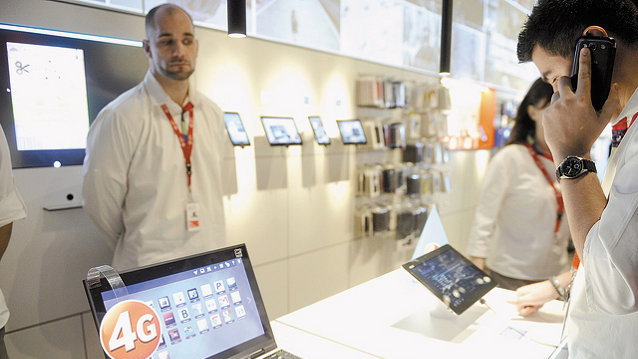
The local divisions of telecom giants Orange (France) and Vodafone (UK) will create a new company to manage the development of the 4G mobile communications network and the fiber optic infrastructure for the two in an unprecedented move for the telecom industry in Romania.
Local telecoms have worked together on infrastructure before, sharing communications towers for instance, but have never taken such a step.
No other major player like Cosmote, RCS&RDS, Romtelecom or UPC is expected to join Orange and Vodafone in the alliance, according to the currently available information. The agreement is nothing new in Europe, as the two groups developed part of the 3G and 2G network in Spain via several agreements and have recently launched a fiber optic infrastructure project.
The two companies declined comment on the information at hand.
However, the chief executive officer of the Vodafone group, Vittorio Colao, told ZF in an interview last December that operators should work together more often on network development including Romania.
“A country like Romania cannot have four different mobile networks and three different fixed networks, it’s a waste of money. We need to focus on the return of our investments more. I have no problem to share some infrastructure with a competitor if I get reciprocal conditions somewhere else,” Colao said.
“I have no problem sharing my network with Orange in Spain or with Deutsche Telekom in Germany because we are long-term operators. Then we compete “like hell” in the shops, in the streets over customers, that’s fine, but the return on infrastructure investment I think is important.”
The two are said to have gone to the Competition Council with their plans for the new infrastructure company to avoid an investigation, as well as to the Communications Ministry.
“I cannot comment on whether the said operators did or did not approach the Competition Council,” said Valentin Mircea, vice-president of the competition watchdog when asked about it.
The competition authority is open to guiding the operators in this provided that they remain true competitors. “We are open to guiding operators so as to enable them to get significant cost savings by sharing the network, on condition that they remain true competitors on the market and this way pass on at least part of these savings to consumers.”
What motivated the two competitors to work together? The steep decline in revenue compared with 2008, by almost EUR800 million together, a fast-paced profit deterioration from EUR744 million to EUR239 million, and the threat of termination and roaming fee reduction.
Market estimates point to an over EUR200 million drop in the revenue of all mobile phone operators as a result of the termination fee cut by the communications market watchdog ANCOM, while operating income should be about EUR100 million lower.
Moreover, another reason for the talks of the two companies is that Orange and Vodafone paid the Romanian government EUR456 million together for their fifteen-year communications licenses in the last six months, which allow them to continue their business in Romania.
The Romanian government held its biggest spectrum frequency auction last year, with Orange, Vodafone, Cosmote, RCS&RDS and 2K Telecom as bidders, and collected about EUR700 million in revenue from it.
The unusual alliance of Orange and Vodafone is also motivated by the strategic risks of not having a powerful fixed communications infrastructure like Romtelecom and Cosmote and RCS&RDS do, as well as a solid customer base for TV and landline Internet services.
(English version by Loredana Fratila-Cristescu)