
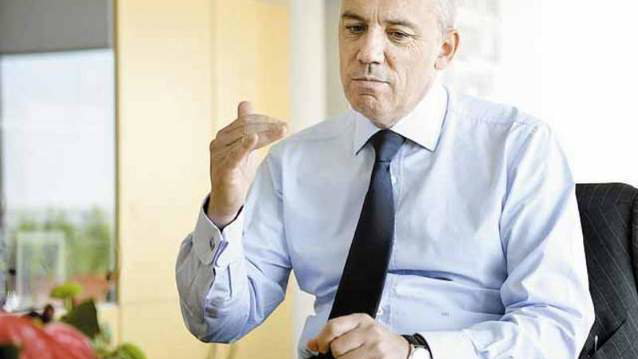
“We have a successful operation here, but it’s not a very easy market,” Richard said. He was in Bucharest on Friday for an evaluation of the Romanian operations.
Orange is betting a lot on the 4G services, which provide new opportunities to grow and attract customers on a highly competitive market where its rivals are Vodafone, Deutsche Telekom (Romtelecom and Cosmote) and RCS&RDS.
The operator has just launched its DTH service, to be able to provide an integrated package also containing mobile phone, landline phone and Internet services. This is the future, Richard says.
Orange plans to expand to other areas such as support, research and innovation centers considering Romania’s IT skills, he added. Romania can be a service platform for other countries, as well, especially when it comes to mobile banking.
Stephane Richard was in Bucharest last week for a review of Orange operations in Romania, which contribute almost one billion euros (EUR925 million in 2012) to the overall revenue of Orange (the former France Telecom) group, generating a EUR116 million net profit in the process.
Before the crisis came and the competition among operators became fiercer, Romania contributed EUR1.3 billion to Orange’s revenue, as well as EUR438 million in net profit.
The French company first arrived in Romania 17 years ago, introducing the Dialog later turned Orange brand, and invested more than EUR1 billion in it. It now has more than 10 million customers for its mobile phone, Internet and DTH services and once the 4G service coverage improves, which provides Internet speeds close to those of landline Internet connections, it will start offering integrated service packages.
One has to invest a lot in Romania and always keep an eye on the latest developments and on the competitors’ moves; it is a market where customers demand and get top quality services at almost the lowest prices in Europe, Richard says.
Orange bought the frequency spectrum licenses for its 4G services from Romania’s government in an auction last year. The licenses are valid until 2029 and the company will pay EUR227 million for them. To keep the network up to date and expand 4G service coverage, Orange needs to invest more than EUR100 million a year.
The company will focus on innovation, efficiency and costs and has high expectations from its newly introduced TV services, Richard said.
Orange and Vodafone dominated the mobile phone market in 1997-2004 when Cosmote, the former Cosmorom, relaunched and started a price and special offer war gaining market share, which currently stands at almost 25%. Orange’s market share is 39% and Vodafone’s 32%, with RCS&RDS accounting for the rest up to 100%.
Once Deutsche Telekom, which acquired control over Greece’s OTE, merges Romtelecom and Cosmote’s operations, it will create a new player that will pose a greater challenge to Orange’s position, telecom’s market number one by revenue, customer number and profit.
Richard says Orange is not afraid, but will closely watch what happens with the competition, because it plans to stay number one in five years from now, too.
Could there be a market consolidation in Romania? Not likely, Richard thinks. Orange joined forces with Deutsche Telekom in the UK to compete with Vodafone and O2, but things are different in Romania.
Stephane Richard spent less than 24 hours in Romania and did not postpone his visit despite the huge scandal in France he was involved in. While in Bucharest, he also met with Prime Minister Victor Ponta.
(English version by Loredana Fratila-Cristescu)