
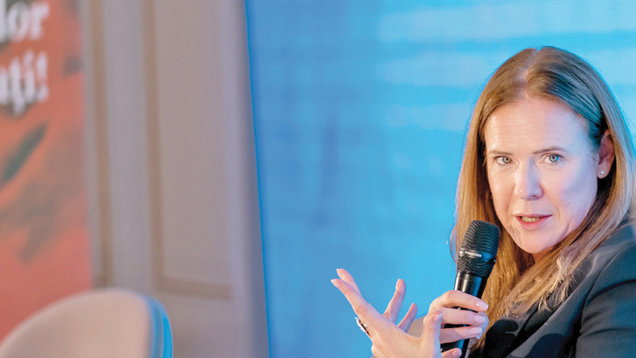
„Our transformation is well underway. Since launching the Strategy 2030 in December 2021, we have invested EUR 5.4 billion to strengthen and diversify our business, expand our presence in South-East Europe and build new growth pillars. The projects currently under development are expected to support long-term growth and create value for all stakeholders,” stated Christina Verchere, CEO OMV Petrom.
For the period 2024–2026, annual investments are expected to average to approximately EUR 1.7 bn, and are set to continue at around EUR 1 bn during the period 2027–2030, reflecting the progress of our strategic projects. Low and zero-carbon projects will account for around 25% of the total investments of 11 billion euro in 2022–2030.
All projects are expected to ensure solid internal rates of return of over 10%.
Also, Clean CCS EBIT is expected to top EUR1.5 billionn in 2030, which represents an increase of around 50% compared to 2025.
OMV Petrom will continue to offer a competitive level of base dividends and special dividends, cumulatively representing approximately 50% of operating cash flow, on average over the course of the strategy cycle.
One of the company’s strategic projects, the Neptun Deep, made significant progress with the installation of the Neptun Alpha platform and the advancement of works on the offshore pipeline and production infrastructure.
Plateau production is expected to be reached by the end of Q3 2027 and to last almost 10 years. The company plans to continue its offshore exploration activities, with the drilling of 2-3 new wells in Romania and Bulgaria by 2030.
As regards the new energy production capacities, mainly solar and wind, will come online gradually, with estimated production for 2030 exceeding 2.4 TWh. The Gas and Power segment relies on a complementary portfolio of assets. This includes the 0.9 GW gas-fired power plant at Brazi, as well as a portfolio of renewable energy projects totaling more than 1.3 GW, of which more than 0.7 GW under construction in Romania and Bulgaria.
In the Refining and Marketing segment, the modernization of assets continues to meet changing mobility needs. Recent investments have increased the flexibility and reliability of the Petrobrazi refinery, enabling it to process a diverse range of crude oils and supporting an average utilisation rate of over 95% until 2030 in years without planned turnaround. Petrobrazi is becoming an integrated platform for the mobility of the future, with the addition of the SAF/HVO unit and inclusion of green hydrogen in production processes. Construction works for the first major sustainable fuel production facility in South-East Europe are progressing.
The new unit will produce fuels using renewable feedstock.
Once completed in 2028, the SAF/HVO unit at Petrobrazi will have an annual production capacity of 250,000 tons. All modules for the two green hydrogen FID-ed electrolyzers, with a combined capacity of 55 MW, have recently been delivered.
By 2030, the company plans to expand its biofuels and green hydrogen capacities with new projects currently under evaluation.
In Retail, OMV Petrom will continue its dual-brand strategy, optimizing its network and expanding into high-traffic areas. The company will further develop its non-fuel offer and digitalization initiatives to maintain its position as the preferred choice for customers. In e-mobility, OMV Petrom is already the largest player in Romania and expects to further expand its regional network to around 5,000 charging points by 2030.
OMV Petrom is listed on the Bucharest Stock Exchange, with a 28.1% free float. As of end-2025, Romanian shareholders held around 45% of the shares (of which the Romanian state held 20.7%, and 24.4% were owned by pension funds in Romania, as well as other Romanian natural persons and legal entities). OMV Aktiengesellschaft held a 51.2% stake in OMV Petrom, and the remaining 3.7% were held by other foreign investors.
(English version by Catalina Apostoiu)