
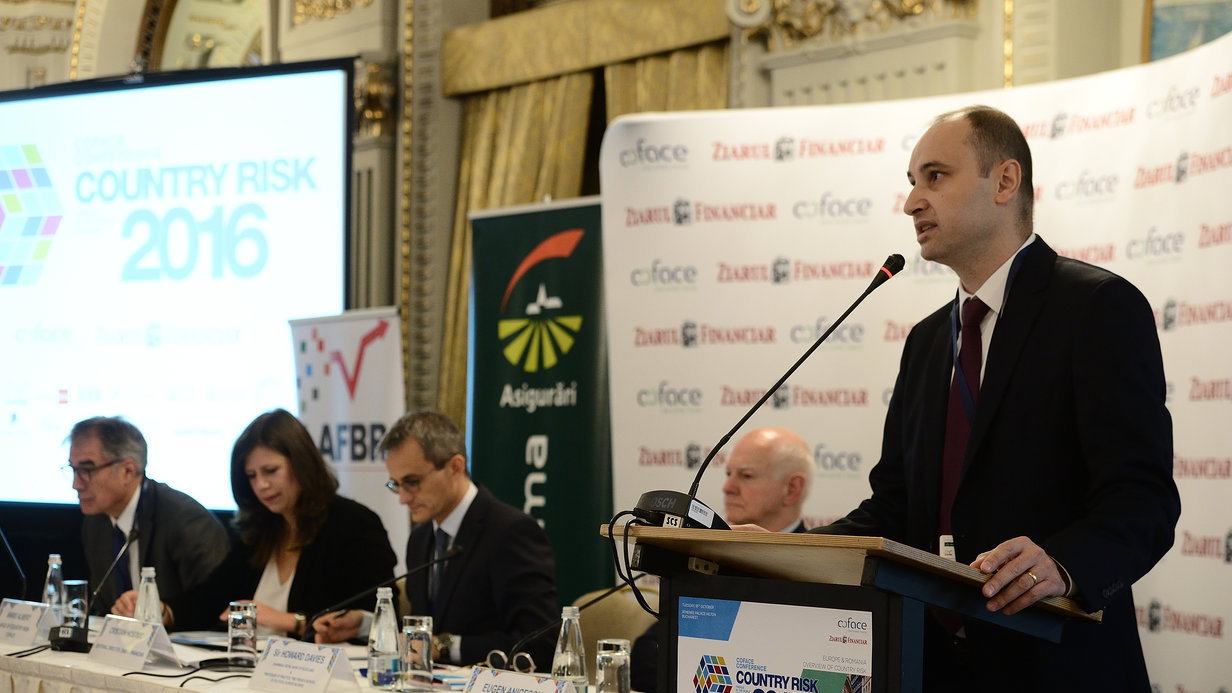
“We are experiencing a paradox: the best possible macro situation for Romania, also the highest risks ever,” Isarescu said at the conference on country risk organized by Coface and Ziarul Financiar.
The worst is the economic imbalance risk caused by the too fast increase in demand against the supply and the key mission to avoid it is the improve productivity, he added.
Economists worldwide are constantly talking about stimulating the economic growth, but it is important for local actors not to focus solely on economic growth but also on how that growth is achieved, Isarescu said.
“The country risk is not a matter of macroeconomic indicators only. It includes many subtle principles of the rule of law and market economy.”
Even though Romania is doing very well macroeconomics-wise, the central bank governor says the risks are all the greater. “When you fall from the first floor, it’s not a big deal, but when you fall from higher up, there might be a problem.”
Despite the mounting global economic uncertainty, Romania is in a macroeconomic and political stability area, which leads to higher consumer spending, but the actors must not let this influence them and lose touch with the global situation, said Eugen Anicescu, country manager of Coface Romania.
“Brexit does not have a negative impact on the economy yet, but we do not know where things will go from here. Most European banks remain less profitable than they were during the crisis,” said Howard Davies, chairman of Royal Bank of Scotland.
While the US and Canada will see the fastest economic growth compared with last year, the UK will see its economy slowly decline, due to its decision to leave the European Union. On the other hand, China remains a key factor for the world economy. If these countries step on it, the other countries, too, will witness fast-paced growth in 2017, if not, we can be talking about a recession, Davies added.
Romania will end 2016 with an economic growth of 5%, according to the fall forecast of the International Monetary Fund. This is higher than Ireland’s, which had a record growth of 26.3% last year, compared with Romania’s 3.8%.
“It is not wise, while focusing on how fast we grow, to ignore how we do it. I am glad we’re seeing this question more and more often: we’re growing at a rate of 5% but is it sustainable or balanced?” Romania’s central bank governor Mugur Isarescu said.
The bad news is that the economy cannot possibly achieve a sustainable growth rate of 5% a year based on monetary, fiscal and wage incentives, which will unavoidably have to be withdrawn sooner or later. The good news is that the economy can be brought to a sustainable growth rate of 5% a year by implementing an all-encompassing structural reform program (…), said Romania’s central bank chief economist Valentin Lazea.
Romania may have tripled its GDP in ten years, but its growth was not healthy, though the crisis did have a positive effect in this respect, said Friedrich Mostbock, vice-president, EFFAS& Head of Group Research & Chief Economist Erste Group Bank AG, at the ZF and Coface conference. There will no longer be such things as booms, only moderate growth, but that is more sustainable in the long run, he added.
Romanians must understand what the mechanisms behind the 5% growth in the first half are, the speakers at the conference said.
(English version by Loredana Fratila-Cristescu)