
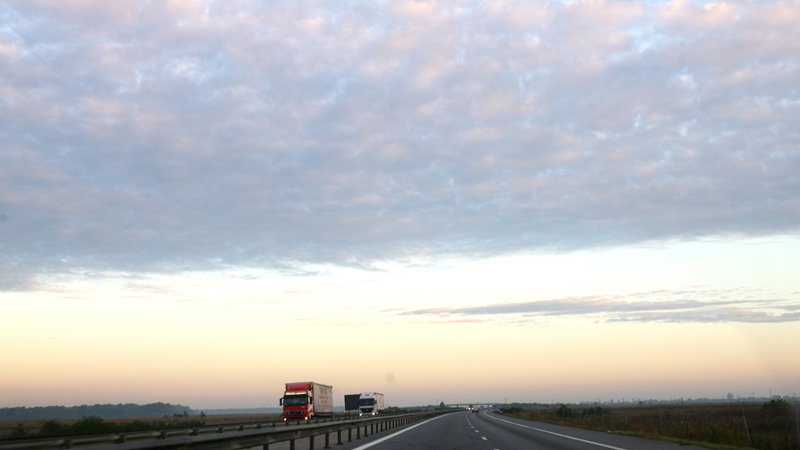
Although the government said last year it would be completed by 2016, the highway is now on the list of “future projects”.
“The government is making a huge mistake if it does not continue with this highway,” local carriers quoted by Business Construct magazine say.
The government spent some EUR2.5 million in 2007-2008 on the feasibility study of the Sibiu-Pitesti highway and last summer announced it was willing to pay almost six times as much to have the study revised.
The Sibiu-Pitesti highway has been put on hold since and CNADNR cannot even tell whether the road will be built in the coming years or not. Moreover, the entire highway corridor that should connect Constanta (SE Romania) to Nadlac (western Romania) on the border with Hungary is supposed to no longer include Pitesti and Valcea cities, but take the Ploiesti-Brasov and Fagaras route.
“Sibiu-Pitesti is a very expensive highway and when I say expensive I don’t mean just money, I also mean environmental impact (…) There is an option we thought about, Sibiu-Brasov, which is much cheaper, at least half of the Sibiu-Pitesti price,” said Narcis Neagoe, general manager of CNADNR, during the national construction conference organized by ZF and Business Construct.
“To connect Corridor IV it would make sense to no longer go from Sibiu to Pitesti but to Brasov and then to Predeal-Comarnic. It’s one of the scenarios we are considering.”
According to the 2007-2008 feasibility study, the cost of the 116-kilometer long Sibiu-Pitesti highway should be EUR3.2 billion. The investment should have initially used European funds and the Romanian government’s contribution should have been 15% of the total.
CNADNR started preparing the tender to award the contract for the revision of the feasibility study last spring when the Transport Ministry, which oversaw the company, was run by Democratic Liberal Party (PDL) member Alexandru Nazare.
The tender estimated at a little more than EUR14 million was cancelled in November, while National-Liberal Party (PNL) member Ovidiu Silaghi was transport minister.
CNADNR was transferred to the Department for Infrastructure Projects and Foreign Investment run by Social-Democratic Party (PSD) member Dan Sova early this year. Early September the company announced plans to redo the feasibility study for the Sibiu-Pitesti highway. End-September, things changed.
“We will try to start a tender for the feasibility study for Sibiu-Brasov, to see the costs exactly. It also makes sense that when going to Moldavia we should have a Brasov-Bacau highway. This way Brasov would connect all three Romanian provinces: Transylvania, Wallachia and Moldavia,” CNADNR’s general manager said.
Sibiu-Pitesti highway, considered difficult to build because it crosses the mountains is the only section of the European Corridor IV without a specific timeframe for start or completion of construction work.
“The priority is to connect Sibiu and Pitesti, as commercial traffic values show. They (CNADNR i.e.) are still thinking (…). I don’t know what interests are at play there, it probably has to do with land,” says Augustin Hagiu, transport industry consultant.
European Corridor IV starts in Romania in Nadlac and ends in Constanta and only 425 kilometers of 800 connecting western to eastern Romania are open for traffic. A further 110 kilometers, the Orastie-Sibiu section and the first segment of the Lugoj-Deva section are currently under construction and should be completed this year or in 2014 at the latest, according to the latest CNADNR estimates.
Construction work on other Timisoara-Lugoj-Deva sections is due to begin in the next few months or in the spring at the latest.
“Everybody is eagerly awaiting this Sibiu-Pitesti highway, particularly because Olt [River] Valley is a real ‘valley of death’ for road transportation. The government is making a huge mistake if it does not continue with this highway,” says Ion Lazar, who controls road carrier Lazar Company in Pitesti, with a fleet of more than 860 vehicles.
“This road would generate tremendous benefits, our trip would be 50 kilometers and one hour and a half shorter. Moreover, we would also gain when it comes to truck wear and tear costs, because traveling at constant speed on a highway is one thing and using the break often on the Olt Valley is another.”
Moreover, Romania’s most important plant, Renault-owned Automobile Dacia is located in Mioveni, close to Pitesti. The plant will reach a production peak of 343,000 cars this year, most of which built for sale on Western markets. To reach Western Europe from Mioveni, one has to take the Olt Valley route or use the railway, another infrastructure sector that is suffering in Romania.
Renault has repeatedly said Romania needs to invest to stay competitive, considering its Dacia plant in Tangiers, Morocco is connected to the sea via a 32-kilometer highway with two lanes per way and by railway. In Romania, it took seven years to build a 7.3 kilometer road that makes it easier for the plant in Mioveni to get the supplies it needs.
(English version by Loredana Fratila-Cristescu)