
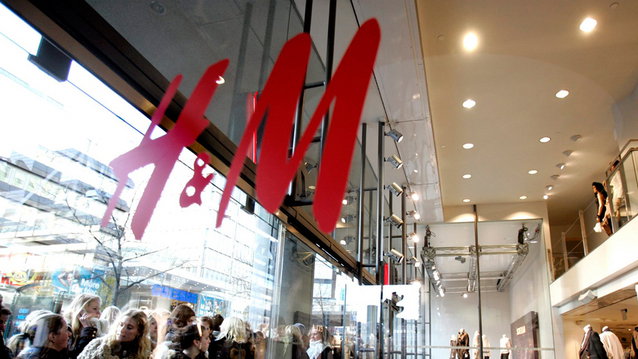
The designers make the sketches, the sewing is done in Romanian plants and the clothing is then shipped to other countries.
“Once every two or three months we make a collection for H&M, we present it in Sweden and their buyers choose sketches, which then become our orders,” says Gabriela Gherghina, head designer of Ottorose Rom. The name Ottorose Rom first grabbed the headlines a few days ago, when Swedish retailer H&M for the first time released a list of its international suppliers, including Romanian ones.
The Romanian list consisted of nine suppliers and 20 plants where the Swedish giant made clothing under the H&M brand. The name featuring most heavily on this list is Ottorose Rom, which makes the clothing both in its own plant and in five other production facilities which it subcontracts.
“If [H&M for instance] orders very large quantities, we subcontract to other plants. Otherwise we try to make the clothing at our own plant. But we have focused on the design part and are mainly a design office,” explains Gabriela Gherghina, who is a graduate of the decorative arts and design faculty in Bucharest and has worked for Ottorose Rom for six years. Ottorose Rom’s design office employs 20 people – some do the actual design work and some make the patterns.
According to Finance Ministry data, Ottorose Rom, held by businessman Lycourgou Michalakis, had 25 employees and a turnover of 10.3 million lei (EUR2.5 million) at the end of 2011, the latest year for which data is available.
“In the last two or three years we have focused our attention on the design side. Previously we used to do toll manufacturing, i.e. the retailer sent the pattern to Romania,” she explains. Currently Ottorose Rom receives increasingly more orders for its own patterns. In addition to H&M, the Romanian company has also signed contracts with two UK companies – Coats and Oasis.
“We have focused on making special products, that’s why we get orders for 20,000 to 150,000 items per pattern.” Gabriela Gherghina says for simple, basic articles orders reach up to 300,000 items. She does not give details about the total number of orders in a year.
“We mainly make dresses and tops. After the patterns are given the green light and the items of clothing are created at our plant or at those of our subcontractors, the articles end up being sold in stores all over the world, given that we get orders for tens or even hundreds of thousands of items per pattern.”
Romania is traditionally a market for toll manufacturing, where major international retailers – either mass-market companies (H&M, Zara and C&A) or luxury ones (Gucci, Dolce & Gabbana) – make clothing in local plants, which then ends up in stores all over the world. The business model entails that the plant tailors and sews the item of clothing based on a sketch and a pattern sent by the international retailer.
But in Ottorose Rom’s case everything that goes into making the item of clothing is done at the Paulesti plant.
H&M manufactures clothing in 20 plants in Romania, with a turnover of around EUR100 million and 7,000 employees in total. Manufacturers and retailers refuse to provide official information on the price of articles, but according to ZF information supplied by market players, store prices can end up being as much as ten times the ex works price.
H&M has recently published the names of its international suppliers. Romania is, alongside Bulgaria and Turkey, one of the company’s main suppliers at European level.
H&M, which has been present in Romania as a retailer for about two years, has a 24-store network and a turnover of EUR74 million in financial year 2012.
(English version by Daniela Stoican)