
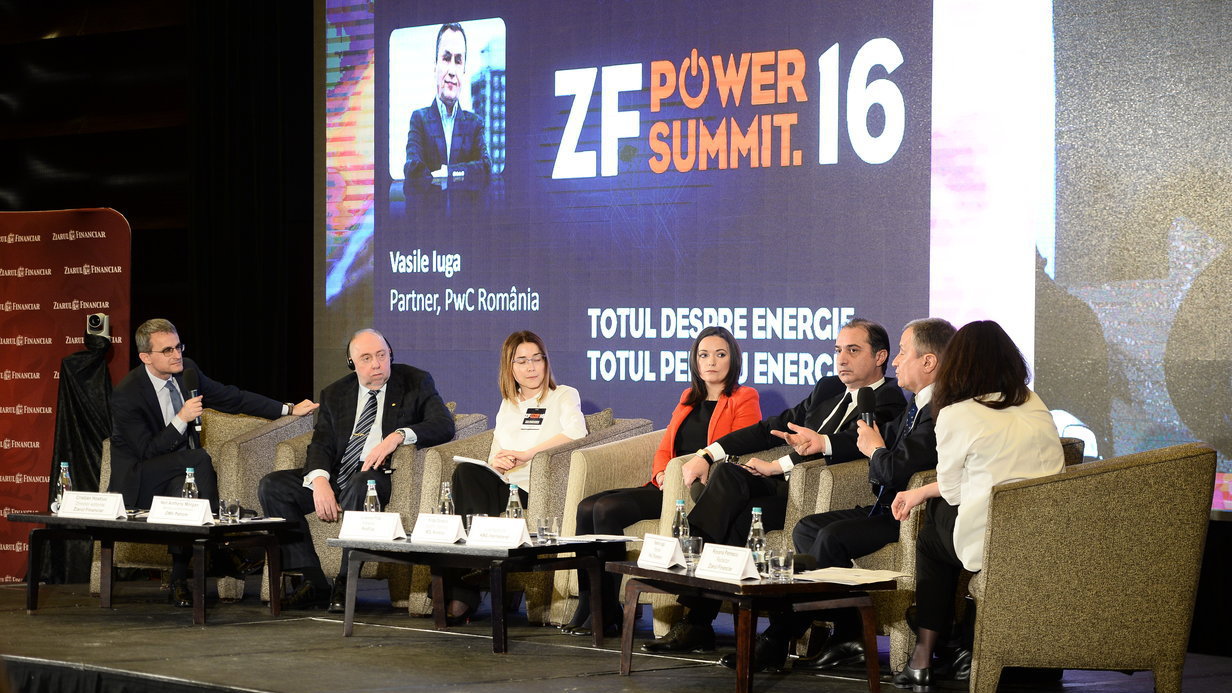
Oil companies and natural gas and transmission companies are considering investments for the near future but reiterate the need for legislative predictability. The companies in this business are also carefully watching the trend of the oil price and hope it will return to a more profitable level. In turn, Energy Minister Victor Grigorescu reassured them the strategy would be done by the fall.
“We will see the energy strategy, a strategy of Romania this fall, but some parts of it will be discussed before that. The energy sector can generate growth,” Victor Georgescu said at the opening of the fifth ZF Power Summit edition.
This is the most important energy industry-related event organized by Ziarul Financiar, whose partners were Engie (former GDF SUEZ Energy Romania), Hidroelectrica, Rompetrol, CEZ, Electrica, Electroalfa, Marsh, Microsoft, MOL, Nuclearelectrica, OMV Petrom, Siemens, Enel and Transelectrica.
“As long as hydrocarbons remain the drivers of the major economies, the decline of the oil price will hinder development,” said Catalin Dumitru, vice-president of KMG International. The company made profit from the very good refining margins last year, which it hopes will continue in 2016. Its investment will be directed to the refining and petrochemical business because retail margins are lower.
Neil Anthony Morgan, member of OMV Petrom’s Executive Board, announced potential investments in the Petrobrazi refinery and said he hoped the $100 oil barrel would not be history in the next five years.
“Predictability is key. When one invests tens of billions, one needs to know one is operating in stable regime.”
As for the natural gas segment, the most debated project was BRUA (interconnection of the natural gas transmission systems of Bulgaria, Romania, Hungary and Austria), which will entail construction of a 550 kilometer bidirectional pipeline from Podisorul to Hungary. The EUR560 million investment was devised for two phases, and the second phase will depend on the discovery of gas reserves in the Black Sea.
“BRUA makes sense even if there were no Black Sea and no gas in the south. We will go ahead with the second phase only if there is gas in the Black Sea and we build the pipeline to Hungary. As for phase one, we need that anyway,” said Ciprian Alic, head of the department for accessing EU funds and international relations of Transgaz.
Analyzing the trend of natural gas consumption, the participants to the summit said how important it was to rebuild the chemical industry, the main consumer in the past. Vasile Ciolpan, energy trade director with Romgaz, estimates 2016 consumption will match the 2014 levels.
“As a country with two natural gas producers, it is very important to not end up in a situation where people do not have gas resources.” Consumption only increased on certain segments ant the decline in the chemical industry will continue, he added.
Consumption is an issue Mihai Anitei, general manager of chemical fertilizer producer Azomures highlighted, saying that in the absence of a strong chemical industry, all the Black Sea gas will be exported.
A surprise in the energy sector might come from Iran, which might make an investment in Romania.
“Before we get to invest in Iran, Iran might invest in Romania,” said Razvan Nicolescu, executive lead advisor with Deloitte. He would not comment any further on the issue.
The energy sector needs investment, Ioan Rosca, chief executive officer of Electrica, too, says, because most of the grid is old. Romania needs to make massive investments in the grid, substations due to the lack of automation and the demand for modern technology and equipment.
On the other hand, any major project in the industry suffers because of the lack of predictability of laws and regulations, as the lack of predictability on a regulated distribution market is worse than a bad decision.
Another hot topic for this year is the deregulation of the market and consumer migration from an electricity supplier to another. Martin Zmelik, CEO of CEZ Romania, warns consumers to look not only at the power bill but also the extra services provided and the history of the company itself.
“This year is the year of decisions, for the national strategy, for the renewable energy. I hope the solution will not be postponing and moving problems to another year. We can no longer postpone, we need predictability. We need solutions.”
This predictability and long-term strategy is what consultancy and law market actors, too, want, who also demand a rethinking of royalties.
Moreover, investments in the energy sector not only ensure national security, but also jobs, without which the pressure on the unemployment budget will increase a great deal.
(English version by Loredana Fratila-Cristescu)