
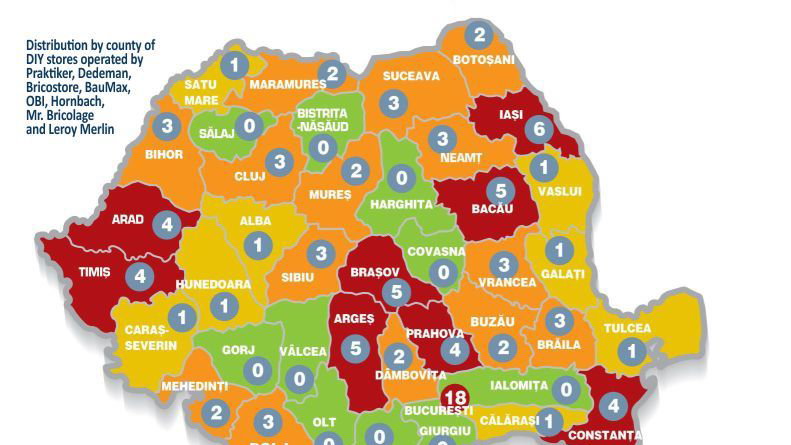

From a peak in 2008, when 18 new stores opened, 2011 will be the slowest year for expansion in the last seven, although some networks have only a handful of stores.
The average investment in a DIY retail store is about EUR10 million, meaning the networks put EUR1 billion into their roughly 100 units in Romania, hiring 12,000 employees. This meant good business for the construction companies that built the stores and exposure for the hundreds of material suppliers, who sold about EUR1 billion in wares through these networks last year alone.
However, the pace of expansion is not the same, as counties like Arges, Brasov or Iasi have at least five DIY hypermarkets, while Bucharest has 18.
Still, there are ten counties untouched by the DIY chains. Some of them meet the requirements: cities with 100,000 inhabitants and a good level of new housing construction, as is the case with Bistrita and Ramnicu Valcea. These two cities are not completely off the map, as the Sibiu-based Ambient network has stores in both, but their format is smaller than that of the traditional DIY chains, and more than half of their turnover comes from distribution.
Ramnicu Valcea has about 110,000 inhabitants and almost 1000 new homes were built in Valcea county last year, while Bistrita has 84,000 people and housing production exceed 800 units last year.
Other towns that might prove interesting to the DIY chains in coming years, though they have not attracted investments so far, are: Slatina (77,000 people and 564 homes last year), Targu Jiu (95,000 people and 395 homes) or Zalau (64,000 people and 540 homes). The chains have already entered cities of similar size, like Alba Iulia (Dedeman), Resita (Dedeman) or Calarasi (Bricostore).
Expansion plans
Targu Jiu, Valcea, Slatina and Bistrita are the future targets of Bacau-based Dedeman, which intends to keep its expansion pace next year. Representatives of the company controlled by brothers Adrian and Dragos Paval did not give details on the future stores, but according to information on the market, Dedeman might open stores in Bistrita and Valcea, and its second in Constanta, next year.
The Austrians at BauMax are planning openings in Cluj and Oradea next year, Hornbach is building a new store in Timisoara, and Leroy Merlin owns land in the Electroputere business park in Craiova, which will host the company’s second store on the Romanian market. “A little more and we will take off,” says Cristinel Petrescu, in charge of Leroy Merlin’s expansion.
Bricostore, Praktiker and OBI are, for the time being, keeping quiet about their expansion strategy, as the crisis and stiff competition have affected their revenue estimates.
OBI intends to continue expansion and investments in Romania, and is analyzing new locations and proposals in the new market conditions, says general manager Romano Quinzi. He admits that, at the moment, there aren’t many developers and investors interested in building commercial parks in Romania, but the company’s objective is to be part of the best commercial developments, alongside other important retailers.
OBI is evaluating certain projects in Bucharest, Craiova, Cluj-Napoca, Timisoara, Constanta, Brasov and Galati, cities that remain on its list of priorities, says Quinzi, adding that, in some cases, the company is considering buying land to develop a store on its own.
Mr. Bricolage also has no solid plans for expansion. “Our strategy is still being discussed, so we will probably have some news next year,” company officials said.
When is it time for consolidation?
DIY retail players have been saying for years that the local market is crowded, meaning mergers and acquisitions are to be expected, especially for chains with few units, like OBI, Hornbach and Leroy Merlin. Some scenarios say the “little fish” will buy out the “big fish,” with transactions carried out between companies with shareholders in the same country.
Until then, 2012 is shaping up to be another year in which only Dedeman will bet on expansion, as foreign chains wait for the domestic and European economy to stabilize, given that strategic decisions are most often made not in Bacau or Bucharest, but in Cologne, Dusseldorf or Paris.
(English version by Radu Bostan)