
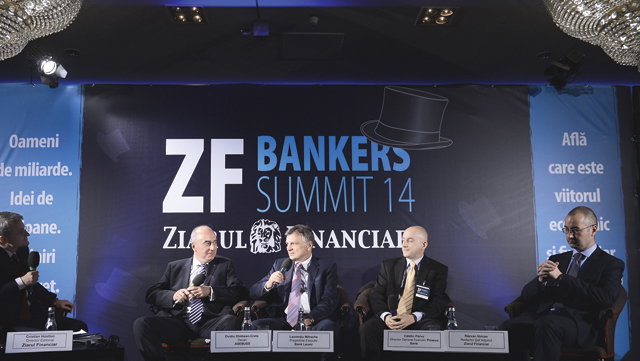
“We are trying to better assess risks and speed up decision-making, but it’s not easy. We need to cut red tape because the mere opening of a current account takes way too much time,” said Laurentiu Mitrache, chief executive of Bank Leumi.
“Market share is not the most important. For instance, we made profit on a mere 0.3% market share last year.”
The ZF Bankers Summit ’14 conference was organized in partnership with MasterCard, Volksbank, Vodafone, Raiffeisen Bank, Alpha Bank, Romsys, Garanti Bank, Kredyt Inkaso, Predoiu Law and Marfin Bank.
Catalin Parvu, general manager of Piraeus Bank, says that all the banks with not so visible market shares have realized in the past few years that they need to look for a niche to be competitive.
“The area we’re headed to is the medium-sized companies with more than EUR5 million revenue and serving the employees thereof. Our strategy is to boost revenue from fees because it is less riskier than relying on interest revenue.”
Bankers say the main problem of the banking system is the too high volume of non-performing loans, about EUR10 billion, generated by the optimism before the crisis, by the frauds involving fake documents and by the fact that the banking system is overcrowded, while the real economy is not regulated at all.
“I don’t know why it had to take so long before provisioning non-performing loans and resuming loan sales. Lending developed too fast before the crisis and banks had too much inexperienced personnel,” believes Ovidiu Dimbean-Creta, dean of the Asebuss MBA program.
“What’s needed now is a greater rebalancing of the operational activity and the risk analysis.”
Small banks hope to survive on a market where 40 competitors are fighting over merely EUR80 billion assets. Most experts say there are too many banks on the market and their number will drop in the coming years, especially since some foreign groups have already signaled intent to leave the Romanian market.
Bank Leumi’s Laurentiu Mitrache says there are not too many players and the market actually has room for more.
“I don’t think there are too many banks. It would be dangerous to have too few players because there will be no more competition. There should be even more, but the market is no longer attractive, unfortunately.”
Doros Ktorides, president of Marfin, a bank in search of a buyer, too, believes there is room for new arrivals on the market. He says Marfin has quite a number of buyers interested.
“There is potential for the future. The country is underbanked. I think there will be new arrivals on the market in the future. For instance, there is no large German bank here.”
Rasvan Radu, chief executive of UniCredit Tiriac Bank does not think there should be much fewer banks on the market than there are now.
“I don’t see a significant decline in the number of banks over the next five years. Maybe there will be about 30 banks remaining. Assets will increase if the annual economic growth reaches 5%.”
(English version by Loredana Fratila-Cristescu)