
Romania is one of the biggest clients of the International Monetary Fund (IMF) in the European Union, and the country, unlike others, continues to benefit from the technical and financial assistance of the World Bank, ranking third in terms of volume of investments in the portfolio of the European Bank for Reconstruction and Development.
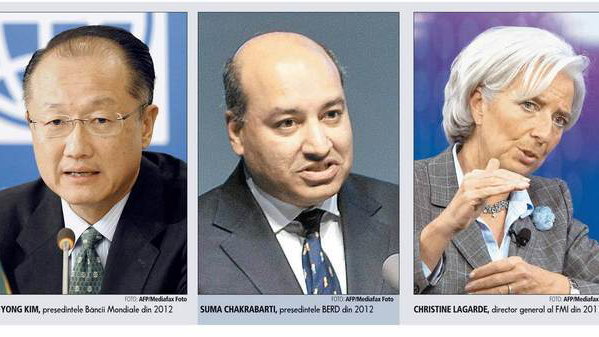
The first visit was that of Jim Yong Kim, president of the World Bank, in early May, Sir Suma Chakrabarti, president of the EBRD, came this Monday, and for the third time since the fall of communism in 1989, an IMF chief will visit Bucharest shortly.
Christine Lagarde, chief of the IMF, is expected in Romania ahead of the Washington Board on June 26. The Board will discuss whether Romania meets the criteria to complete its precautionary agreement, which has already been extended. The visit of the Fund’s general manager has been announced by Romanian prime minister Victor Ponta.
Under the current global circumstances, characterized by slow economic growth, high financial market volatility, a decline of foreign investments and a stronger role played by international institutions, questions emerge as to the visits of the three major bosses to Bucharest within such a short space of time. Also important are the meaning and the impact of the visits of the heads of the three major international institutions.
“The visits of the heads of the IMF, the World Bank and the EBRD can draw attention and put the spotlight on Romania and can enable foreign investors to better understand what is happening here and have more confidence in opportunities in Romania. Of course it would be very good if Romania also attracted the visit of major heads of banks and of major international companies,” comments economic analyst Aurelian Dochia. He adds that Romania has in fact lost ground in many international rankings in terms of competitiveness.
The interest of the three financers is no surprise given their exposure to Romania: The IMF and the World Bank became Romania’s main creditors after 1990 and provided Romania with a huge package of around EUR20 billion in 2009, while the EBRD has reached a business volume of over EUR6 billion since 1991.
In the past four years, 90% of the new foreign money that has come to Romania has been borrowed by the state, while private companies and banks tend to renew their financing lines. Romania’s total foreign debt, which includes both the state’s debt and the private-sector debt, has exceeded EUR100 billion, from EUR21 billion in December 2004 and EUR72 billion in December 2008.
The visits of the three heads of the IMF, the World Bank and the EBRD are also good for their own image, with the programs implemented by the three financial institutions in Romania likely to be advertised as “success” stories.
Romania could be regarded as a “model student,” Dochia also said. On the other hand, dependence on this type of institutions can raise questions, at a time when more advanced countries in the region, such as Poland and the Czech Republic, have for several years worked mainly with private financial groups. In addition, the permanent need for assistance from institutions such as the World Bank and the IMF reveals major weaknesses in the authorities’ administrative capacity and expertise – especially in terms of economic and fiscal policies. Before the crisis the IMF had ended up having to justify its reason for being and looked desperately at how its revenues dwindled because the IMF did not have who to give funding to.
But in 2009 Romania became a major client once again and now the Romanian authorities are considering a third successive loan agreement, although they need waivers for not meeting certain commitments.
(English version by Daniela Stoican)