
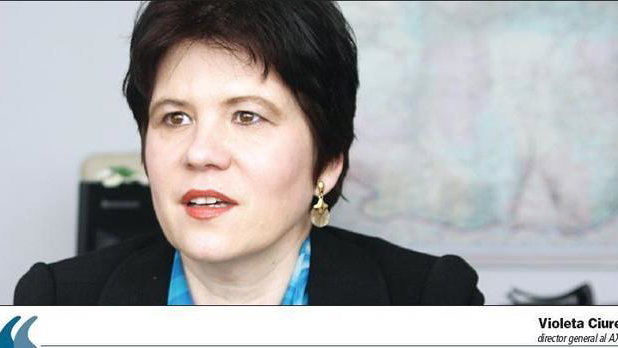
She came back to Romania to helm an insurer with an estimated EUR10 million this year, the subsidiary of French-held AXA.
Seven years ago, in 2004, she left to Amsterdam for a job at ING’s headquarters, after she had propelled ING Asigurari to the top of the local market as CEO.
What is it like to go from business of over EUR100 million and then of tens of billions of euros at the parent company to no. 12-13 on the Romanian life insurance market? What is it like to basically start again?
“It’s a challenge, a route you need to pursue. Past success is no guarantee for the future. One important condition is to know the business. You need a very good team. You know what they say – when you fail, you fail alone, when you succeed, the success belongs to the team,” Ciurel says.
According to her, creativity plays a key role in the insurance industry. “Competition is high, so you can only stand out through creativity and innovation.”
What has the first year been like?
“It’s been an intense year in terms of decisions. We had to pursue several directions at the same time: restructure the team, launch the brand, revise the product portfolio, manage the portfolio of existing clients,” Ciurel says.
Ten-15 years ago, Violeta Ciurel massively promoted unit-linked products as marketing manager and then as CEO of ING Asigurari. Unit-linked insurance saw significant declines during the financial crisis, which amounted to losses for clients.
“Unit-linked insurance is very good insurance. But the client needs to understand how it works. It is a product that entails both investment, and protection.”
Ciurel admits that at the moment, and considering the volatility on the financial market, people are turning towards traditional, guaranteed products, which offer more protection.
Ciurel was also a promoter of private pensions, but the 2008 financial crisis brought major changes to this sector, too.
Hasn’t the crisis destroyed the model of saving for private pensions considering that governments in other Eastern European countries such as Poland and Hungary decided to freeze the reform or even reverse it?
“I don’t think these models don’t have a future, quite the contrary. The defined benefits model – under which the state or companies commit to saying a certain amount of pension) cannot be pursued under any circumstances.”
How have clients changed, what is their attitude towards life insurance policies now as opposed to 10 years ago?
“The entire financial market is affected by clients’ relationship with banks. People are now indebted and find it much harder to commit to long-term payment obligations,” Ciurel says.
Indeed, between 2000 and 2008 the volume of loans taken out by individuals went up from EUR1 billion to EUR25 billion, and has been flat in the last two years.
Encouraged by the strong economic growth recorded between 2004 and 2008, which was accompanied by public sector wage increases, followed by a similar trend in the private sector, Romania’s middle class thought more about spending than about saving during these years, but now it tends to hang on to cash.
“People no longer part with their cash as easily as before. We have noticed a decline in confidence in the entire financial system. However, people are less afraid of insurers than of banks.”
The Romanian society has changed very much in the six years of her absence, Ciurel says.
She was gone exactly during Romania’s economic boom and lending growth – between 2004 and 2010.
“There is a much bigger difference between people’s expectations from companies and companies’ expectations from people. For instance, work in a multinational is no longer a mirage. In ’95-96 to work for a multinational was a prestigious job. Now many expect very significant benefits without a sustained effort,” says the manager of AXA.
There are also changes in terms of people mentality.
“In other countries, people think more about saving. Here people are still inclined towards spending money. They spend money much too easily. They don’t think long term. People have holidays and luxury cars on their minds, the party is in full swing. Too few of them think about their career, or how to perform as well as possible.”
Violeta Ciurel is also a university professor at the Academy of Economic Studies in Bucharest.
How did she learn how to be a manager and what is the difference between managers in Romania and those in the Netherlands?
“It is very important to be a disciplined person in order to be able to impose discipline. To keep deadlines, be of help to people permanently and be upright.”
Abroad, managers are less close to their teams, Ciurel says.
“Managers delegate more and are more modest than Romanian ones. In Romania, one’s position in the company is important for people, they feel like this affords them social status. In the Netherlands and other Western countries one’s social status does not depend so much on one’s position in a company. There is more show-off here, over there pragmatism is more often to be found.”
On the other hand, Romanian managers are more conscientious and more involved. “My advice to young managers is to go abroad for a while, work in a different culture, develop themselves in a different way. And see how in the West for instance one works in a more balanced way, people are more efficient and make time for themselves, too.”
(English version by Daniela Stoican)