
The Austrian company has already bet EUR380 million on wind projects in Romania and it is too late now to back out of these investments as well.
“We have done them. What can we do now? Remove them?,” says Harald Wechselberger, executive manager of Alpha Wind and CAS Regenerabile, the project companies controlled by Verbund, through which the investments have been made in the Romanian wind farms.
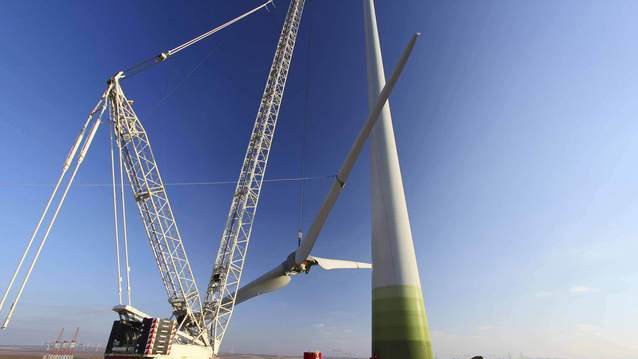
At the end of last week, Verbund announced it had finalized the first stage of a 225-MW wind project located in Casimcea, Tulcea county (SE Romania).
Currently around 100 MW of the farm is working, with the rest to become operational by the end of next year.
In all, 88 wind turbines will be installed, with the overall project being worth EUR380 million. According to Verbund data, the 88 turbines will generate 540 GWh of energy per year, enough to supply 350,000 households in Romania.
Verbund’s official announcement on the stage of the Casimcea investment came shortly after the Government approved the draft emergency ordinance to modify the green energy support scheme ruled by Law 220/2008.
“Originally our project entailed a second development stage, of 57 MW. With just one green certificate, we won’t make this investment,” Wechselberger says.
Considering the value of the investment in the 225-MW project, Verbund spent around EUR1.7 million per each MW of installed capacity. So an investment in the additional 57 MW could amount to around EUR96 million.
The Government approved the emergency ordinance modifying the support scheme for green energy in its meeting early last week.
What the ordinance provides for:
As of July 1 the granting of a number of certificates for each MW – hour generated and delivered by producers of energy from renewable sources should be postponed as follows: one green certificate for new hydro-power stations with an installed power of up to 10 MW, one green certificate for wind power stations, two green certificates for solar power stations.
The postponed certificates will be recouped as of March 31 2017 for hydro-power stations and solar projects, and as of January 1 2018 for wind projects.
As far as solar projects are concerned, the investors are set to get 4 green certificates instead of 6, with the remaining two to be recouped from 2017 onwards.
In total, this ordinance provides for the postponement of subsidies worth EUR1-EUR1.5 billion, according to ZF calculations, with the amounts set to be recouped by investors as of 2017.
Local effects
The modification of the support scheme was mainly demanded by the industry, which threatened to reduce or even shut down activity because of the impact that green certificates have on the bills.
The population has also fully felt the effect in terms of higher bills – they have become around 30% more expensive in one year’s time especially because the cost of green certificates has been included in the bills.
(English version by Daniela Stoican)