
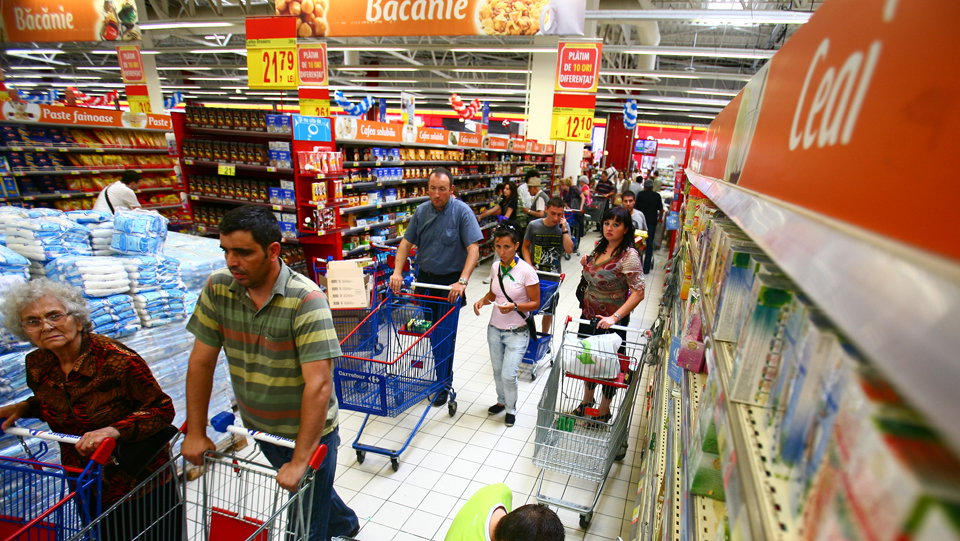
Consumer spending started to decline in 2009, the first year of crisis and has been unable to recover ever since, struggling to get out of the plus/minus 1% range for the past two years.
The International Monetary Fund representatives to Bucharest, however, took the wind out of local retailers and producers’ sails, saying that there can be no VAT cut for other foods unless the impact the bread VAT cut has been properly assessed.
“A VAT cut for all foods would be make them cheaper and implicitly stimulate consumer spending,” says Alexandru Vlad, executive director of Selgros cash&carry chain.
He explained not long ago that consumer spending did not go hand in hand with the economy, which had increased largely because of exports, so special measures should be taken to boost it.
Consumer spending would increase at a double-digit rate in the boom years and drive the economic growth. Now the spending appetite of consumers remains low after five years of crisis during which wages rose slower than inflation, so consumer spending has become the weak link of the economy.
“A VAT cut for other foods, such as meat, is really necessary. The performance of the industry is now threatened by a very high tax evasion, so the VAT cut was a hope that things would get back to normal,” said Grigore Horoi, chairman of Agricola Bacau, one of the largest companies on the meat market.
“Purchasing power is still very low, so a price cut (after a VAT cut i.e.) would stimulate consumer spending, which in turn is a source of growth for the economy.”
The government decided to cut the VAT for bread to 9% as of September 1, and the chairman of the association of milling and bakery companies Rompan, Aurel Popescu, says the step led to an increase of taxed production of flour and bread by more than 10% and 15%. Moreover, bread dropped more than 12% in price.
Rompan’s chairman’s statement is the first public estimate of the first effects the taxation cut has had on the bakery industry. Popescu said that in six to eight months, the informal production would be down to 20%. The milling and bakery market is one of the most heavily fragmented of all and the bulk of sales comes from small and medium-sized companies. Such companies account for two thirds of the market, and large national companies for 30%.
A survey by market research company Euromonitor shows that no company in this business exceeded 5% market share last year.
Government officials have repeatedly said that the expansion of the fiscal relaxation to the meat industry or the sale of fruit and vegetables depends on the success of the bread VAT cut.
IMF representatives, however, have recently said a decision on a VAT cut for other foods can only be made after the government assesses the impact of the VAT cut for bread to 9% as of September. The head of the IMF mission in Romania, Andrea Schaechter says it is too early for the effects of the bread VAT cut to show. The main purpose of this step was to curb tax evasion.
VAT in Romania is 24% except for bread. In Poland, the most developed country in the region, VAT varies with product category, from 5% for meat, vegetables and dairy to 8% for canned foods, personal grooming products and diapers and 23% for cigarettes, coffee and household care products.
“As long as tax evasion on the milling and bakery industry stands at about 70%, the VAT cut from 24% to 9% in this sector will no longer encourage producers and some retailers to resort to informal trade. This way the competition between us, retailers, and the small shops next to apartment buildings and market sellers will become fair,” say the representatives of Profi, a retailer with more than 180 stores in Romania.
They added that informal trade becoming taxed trade will not only result in revenue for the state budget but also create jobs, which can translate in higher revenue from payroll tax, profit tax, dividend tax, all of them going to the state budget.
Sorana Georgia, who runs supermarket chain Billa, says such a measure has to be devised in such a way as to be a win-win-win situation for the government, the business sector and consumers.
A meat VAT cut should not throw the state budget revenue collection off balance.
“The bread VAT cut did not show in consumer spending that much because the product accounts for little of the household budget. Moreover, it did not throw the state budget off balance. If meat VAT were cut, we could see an increase in consumption spending because this product accounts for a significant share of the household budget. Any such step needs to be analyzed so every party could win. Illegal trade has to decline, budget revenue collection should be done correctly and the end price should be low.”
(English version by Loredana Fratila-Cristescu)