
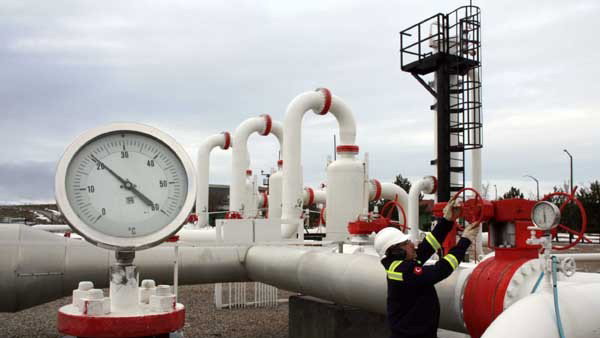
Russia abandoned the South Stream project due to the European Union opposition but will still build a pipeline with a similar capacity, 63 billion cubic meters a year, to Turkey, President Vladimir Putin announced in a news conference in Ankara, Turkey, together with his Turkish counterpart Recep Tayyip Erdogan on Monday, according to Bloomberg.
South Stream should have carried Russian gas to Central Europe without going through Ukraine, crossing the Black Sea, Bulgaria, Hungary and Austria instead. The European Commission was against the project for both competitive reasons, because Gazprom would have been the only supplier with access to the pipeline and for geopolitical reasons, since Ukraine’s position as country of transit for Russian gas is one of the few advantages it has on Russia.
“We can deem this news as positive for Transgaz. Strategically speaking, the Romanian company becomes a more important player in the region. It remains to be seen over the coming period whether this strategic advance can be put to use, but it makes Transgaz more interesting to investors on the Romanian stock market,” said Alin Brendea, deputy general manager of brokerage firm Prime Transaction.
A fully operational South Stream would have made Romania’s role in the region less important, because the Russian gas would have bypassed not only Ukraine but also Romania and gone straight to Bulgaria. The cancellation of the rival pipeline is therefore good news, because it guarantees Transgaz will continue to collect revenue from international transit on long term. The company made 201 million lei (EUR45 million) revenue from transit in the first nine months of this year, which accounts for 16% of its operating revenue.
“The news is neither good nor bad for Transgaz on short and medium term because the construction of the South Stream pipeline would have taken a while, during which its transit revenue would have been constant. This is good news on long term, because its transit revenue would have probably plunged had South Stream become operational,” believes Cosmina Ivana, Swiss Capital analyst.
Transgaz was trading at RON250 on Tuesday afternoon, slightly down from the previous session. It has gone up 38% since the beginning of the year and its market capitalization is now close to RON3 billion.
Even more important for Transgaz is that in the absence of the new Russian gas pipeline, the countries around Romania have no other way but to get their gas via Ukraine, so they are exposed to potential delivery hiccups in case of disputes between Ukraine and Russia. Hungary and Austria get more than 60% of their needs covered by Russian gas, while Bulgaria is more than 90% reliant on that source.
Under the circumstances, the companies in the region are watching the gas exploration in the Black Sea closely.
The first molecules of gas should start flowing from the Black Sea in 2020 and until then the neighboring countries plan to get their connections to the Romanian gas pipeline system ready so they could get some gas does not come from Russia.
Transgaz, too, plans to invest more than EUR750 million in pipelines. A 230 kilometer pipeline set to cost EUR250 million will bring the gas from the shore to Podisor, Giurgiu County in southern Romania. Another EUR560 million will be used for the Romanian side of the so-called gas southern corridor, a huge pipeline connecting Austria and Bulgaria.
In the absence of South Stream, the Black Sea gas will have no other way to reach Europe than Transgaz’s system, in the event Romania’s gas demand is too low.
“The risk of having OMV route part of the gas that could be discovered in the Black Sea to the South Stream in Bulgaria instead of Transgaz pipelines is gone. It is a known fact that OMV was considering South Stream despite EU opposition and since OMV is the majority shareholder of Petrom, the risk could have been significant before this announcement,” said Adriana Marin, chief analyst of Ipopema Securities.
The investment in interconnection with the neighboring counties will pay off and Transgaz will become more powerful in the region only if the companies involved in the gas exploration in the Black Sea decide drilling the deposits there is profitable. ExxonMobil and OMV Petrom are due to announce in 2016 whether they move to the next phase or not.
“It may appear to be an opportunity for Romania, but the reality might prove that this opportunity cannot be economically viable,” analyst Laurian Lungu.
“One can see now, when the oil price is dwindling, that major oil companies postpone or even cancel their projects.”
(English version by Loredana Fratila-Cristescu)