
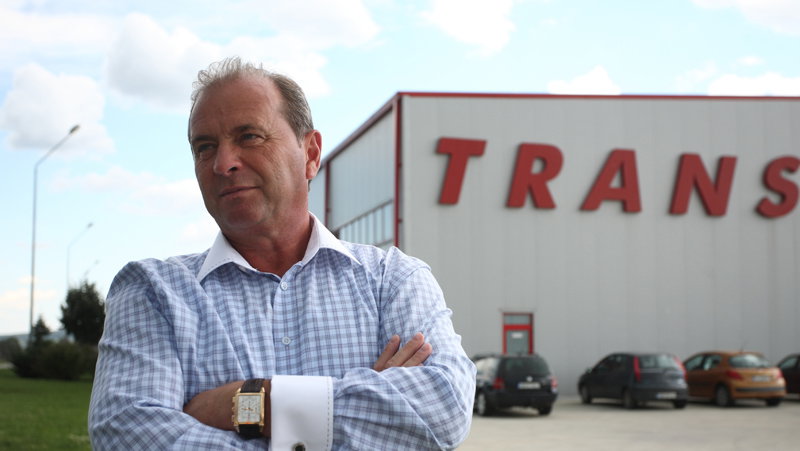

With 25 million chicken growing in 15 farms located in Alba, Cluj, Sibiu, Brasov and Harghita, a combined fodder plant, two reproduction farms, two incubation stations, two slaughterhouses, a meat processing plant and four vegetal farms, Transavia is the biggest player on the domestic meat market with a EUR135 million business last year, an over 10% margin and growth plans for 2014.
Should he sell his business tomorrow, Popa says he would get around EUR200 million, but for the time being Transavia is not for sale.
Beside the meat business, the company also cultivates corn, wheat and two-row barley on 10,000 hectares of land for its own fodder production. This year, it will test the profitability of its own soy production.
“I’m ruling out the possibility of exports being a lifebuoy. The market is unstable, there are many players and large distances. Logistics costs are high,” explains Ioan Popa.
Popa, 57, dedicated half of his life to the family business he created in 1991. After graduating the Faculty of Animal Sciences and Veterinary Medicine, Popa worked for five years in a poultry farm of Sfantu Gheorghe and after the 1989 revolution decided to set up his own business.
“Family businesses are the most valuable and this is how multinationals were born,” says Ioan Popa.
In 2013, Transavia posted record high sales for the group, of EUR135 million, and profit reached EUR13 million, despite the rising price pressures generated by the weak purchasing power.
For 2014, the company plans to invest EUR8 million and revenue and net profit are expected to go up, said the company’s representatives without offering further details.
Around 85% of Transavia’s production is destined to the Romanian market, with the rest being exported to Great Britain, France, Spain, Croatia, Bulgaria, Italy and the Arabian states.
Medium-term plans are to hike export capacities, without putting pressure on the domestic market. Popa mentioned Austria may be one of the future export markets.
Domestically, 75% of the company’s products are sold in major retail chains through Fragedo and Papane brands.
Transavia has a single poultry processing plant. The unit is located in Oiejdea village, Alba county, and was opened in 2008. The production unit, together with the meat industrialization slaughterhouse built from scratch in 2004 and the two cleaning stations fill 14 hectares of land.
The slaughterhouse now operates at full capacity. Popa invested EUR14 million to build it and another 14 million to expand and modernize it.
The company’s two slaughterhouses, of Alba and Brasov, with a capacity of 100,000 chicken per day, employ 250 people.
According to Transavia information, the average salary at company level in March stood at RON3,200. The company has already paid part of its debts and now has a low indebtedness level, planning to pay out all debts in 2014.
Transavia owner is not interested in another business. He says he managed to keep his company growing during the crisis. “The company did not change its strategy during the crisis and posted profit income each year. It was harder for us because the others struggled”.
Transavia is a national supplier for the most important retail chains and also delivers to KFC. “With McDonald’s I am in talks for various products,” says Popa.
Transavia owner rules out the opening of an own store network.
Transavia ships its products through its own fleet, including over 300 vehicles. The company daily transports over 1,500 tons of freight.
(English version by Catalina Apostoiu)