
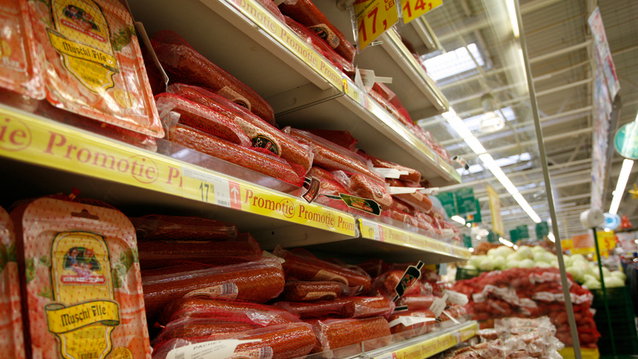
The large production facilities built from the ground up with exports and a fast expansion of multinational retail chains in mind are now oversized, because the business plans the investment decisions were based on were devised around economic growth.
After the onset of the crisis in 2009 the plants no longer had enough customers to operate at full capacity. With consumer spending in decline, some producers saw their profits vanish almost entirely while others ended up insolvent or bankrupt.
“Many plants are oversized. We, the producers, built our plants during the economic boom. We decided for those sizes to keep up with retailer expansion and be able to export,” explains Radu Timis, owner of CrisTim, a company with EUR69 million in revenue last year, which is battling Caroli Foods Group for the top spot in terms of market share.
According to the official meat processors statistics that the Agriculture Ministry has, two of the top ten companies on this market experienced financial trouble over the last two years and another company is already insolvent.
Caroli Foods Group, a joint-venture of Lebanese El Solh family and multinational Campofrio group closed a plant in Tulcea (SE Romania) last year, which was one of two big production facilities it had on the local market.
Aldis, a company owned by the Naghi family, experienced financial trouble after its founder George Naghi died. It sold a livestock farm in a deal estimated at EUR3 million in 2011.
Principal Foods Company, the maker of the Salonta cold cuts, found itself forced to file for insolvency in mid 2010.
The list of major meat processors includes Transavia, which has the largest capacity installed in western Romania, 36,400 tons a year, followed by Elit Cugir (15,000 tons) and C+C in Resita (12,000 tons). The two operate in the same part of the country as Transavia.
The companies owning plants in the south of the country include CrisTim, a plant in Filipestii de Padure (37,800 tons), Fox, which can process up to 12,000 tons of meat a year in a location close to Bucharest and Aldis in Calarasi (15,000 tons).
Competition among producers is much tighter now that the market has shrunk. Whereas the meat and cold cuts market had peaked at EUR1 billion, it has gone down in the meantime to almost EUR800 million at the end of last year, according to ZF calculations.
“The fight is much tougher than the market. The raw material price has surged and the leu depreciated against the euro and producers cannot raise their retail prices to match the other price increases,” says Dan Popescu, plant manager of cold cuts manufacturer Gepeto, which posted EUR33 million revenue last year.
Gepeto owns a meat processing facility in Lumina, Constanta County (SE Romania), whose capacity, 60,000 tons a year, is the highest on the market, according to Agriculture Ministry data.
Still, Sorin Minea, the owner of Angst, which has a plant in Buftea, near Bucharest, and ended last year with EUR44 million revenue, says the positioning and production structure are more important for the development of the business than the actual capacity.
“The production capacity depends first of all on the technological level of the plant. What you manufacture and not necessarily how much is important,” Minea explains.
The production capacity of a cold cuts plant depends directly on the products made, with production declining in proportion to the added value of the products.
(English version by Loredana Fratila-Cristescu)