
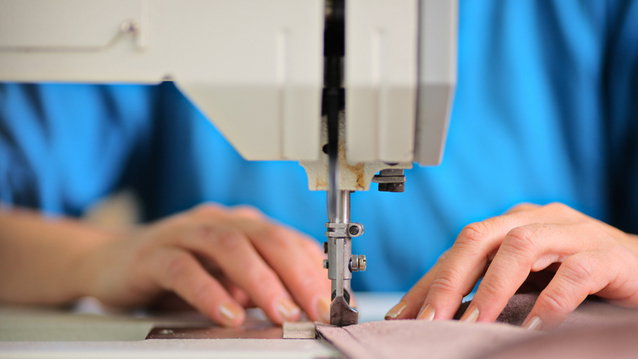
Romania has a long tradition as one of the largest clothing and footwear manufacturers in Europe because its cheap labor, skilled personnel and proximity to Western markets convinced foreign brands to put ‘Made in Romania’ on their labels.
“Textile industry has no wage growth potential. There’s a fierce a competition worldwide, and India, Bangladesh and Egypt are some of the few countries well positioned in this industry because of very low wages,” says financial analyst Aurelian Dochia. “This puts a really heavy pressure on wages.”
The largest ten manufacturers in this business posted EUR510 million revenue last year, 3.5% less than in 2011, according to the ZF Largest Players in the Economy Yearbook (Cei mai mari jucatori din economie) and Trade Registry data.
Although Romania lost some orders to the Asian market, which has been offering even lower wages, the geographic proximity to western markets continues to make it attractive for retailers, especially European ones. Moreover, local manufacturing wages remain among the lowest in Europe.
Employees in this industry get less than 1,000 lei per month (EUR220) per month, most often the minimum wage, especially if the plant is based in any other part of the country but Bucharest. These plants are some of the biggest local employers with hundreds if not thousands of people working for them. The wages stay low because the local economy in those parts of the country does not offer any choice of employment.
Moreover, the textile industry did not survive in any developed country in Europe and the best example in this regard is the United Kingdom, which created the industry several hundred years ago. Meanwhile it lost ground because its inability to compete in terms of wages.
Wages in Romania will not go up even if productivity will.
Many companies in the apparel manufacturing business opened plants in the poorest counties of Romania such as Botosani, Covasna and Ialomita, where people hardly have any choice of jobs.
These employees, however, generated thousands of euros of profits per month. For instance, each of the 179 employees of Benrom (the most profitable of the top ten), generated about EUR52,000 profit for the company last year or EUR4,300 per month, 15 to 20 times more than the industry-wide wage.
Big foreign names with billions of euros in revenue and worldwide operations like Benetton chose to invest millions of euros in developing production facilities in Romania, which generate tens or hundreds of millions of euros in revenue.
Italy’s Benetton has several plants in this country, including the largest producer in the business, Benrom, with EUR132.5 million revenue in 2012.
The company decided to leave local retail keeping only franchised stores.
UK’s Debenhams, too, left local retail where it had been operating through franchisee Octavian Radu. It kept manufacturing operations, making about 5% of the items it sells throughout the world for EUR150 million to EUR200 million according to ZF estimates.
Romania therefore ranks fourth the same as Vietnam among the Debenham’s manufacturers, behind China/Hong Kong (50%), India (12%) and Bangladesh (9%).
(English version by Loredana Fratila-Cristescu)
Top ten largest apparel manufacturers
|
Company |
County |
2012 revenue (mln. euros) |
2011 revenue (mln. euros) |
2012 vs 2011(%) |
2012 profit (mln. euros) |
Number of employees in 2012 |
|
BENROM SRL |
Sibiu |
132.5 |
150.3 |
-11.8 |
9.3 |
179 |
|
ROSKO TEXTIL SRL |
Arad |
78.3 |
78.4 |
-0.2 |
4.1 |
1,201 |
|
RIFIL SA |
Neamt |
65.2 |
63.6 |
2.5 |
4.0 |
492 |
|
ROLANA TEX SRL |
Botosani |
46.1 |
41.8 |
10.2 |
loss |
275 |
|
ITALTEXTIL SARATA SRL |
Bistrita-Nasaud |
42.4 |
34.5 |
22.9 |
0.4 |
405 |
|
ARIES TEXTILE SRL |
Arad |
41.2 |
31.9 |
29.1 |
1.9 |
489 |
|
ALISON HAYES (ROMANIA) SRL |
Ialomita |
40.2 |
29.8 |
34.8 |
0.8 |
1,300 |
|
YARNEA SRL |
Neamt |
32.3 |
37.7 |
-14.2 |
0.2 |
412 |
|
COATS ODORHEI SRL |
Harghita |
31.9 |
31.7 |
0.8 |
2.4 |
420 |
|
PRODUCTIE ZARAH MODEN SRL |
Covasna |
28.4 |
29.1 |
-2.4 |
3.5 |
696 |
|
Total |
510.1 |
528.8 |
-3.5 |
5,173 |
Note: Ranking compiled by ZF based on the Trade Registry data. Only companies whose data was processed until early June are included.
Source: Trade Registry, ZF.