
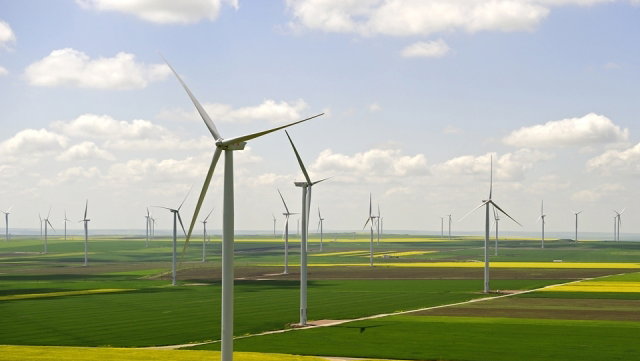

According to data published in early July by the representatives of Transelectrica, the national power grid operator, Romania had 57 large wind projects operational, with a total capacity of over 2,558 MW, the equivalent of four reactors similar with that of Cernavoda.
The companies that manage the 15 largest projects on this list, of which 3 are now being tested, registered revenue worth above EUR418 million last year, according to Finance Ministry data, almost 3.5 times higher than the 2012 level, while profits raked in by these companies near EUR100 million.
The revenue growth comes as many of the projects on this list were completed in late 2012. According to Transelectrica data, while in late 2012 there were 1,822 MW operational in wind projects, at the end of 2013 the capacity of wind mill projects had reached 2,782 MW.
However, the largest part of these energy producers’ receipts and profits does not come from their core activity, namely electricity generation, but from the “subsidies” granted by the Romanian state and paid by all energy consumers.
This support takes the form of green certificates. Wind projects are the greatest beneficiaries of this scheme owing to the size of projects.
Until mid-2013, wind energy producers got two green certificates each for each MWh, so that revenue cashed in from this support topped the revenue generated from the core activity.
Virtually, for each MWh of energy sold, the owner of a wind farm got almost EUR162, with Romania having one of the most lavish support schemes in Europe.
Since mid-2013, though, the Romanian government decided to postpone the granting of one of the two green certificates for investors in the field amid pressure coming from large energy consumers. These certificates are due to be recouped starting 2018.
Wind projects becoming operational this year will get a single green certificate after the support scheme was curtailed.
Even so, wind farm owners’ figures rose significantly against 2012.
For instance, the largest company in the field is Tomis Team, controlled by Czech-held CEZ, which manages part of the EUR1.1 billion project of Fantanele-Cogealac. The company in 2013 reached revenue of almost EUR119 million, 2.8 times higher than in 2012, and net profit of EUR30 million.
Enel Green Power, the company controlled by Italy’s Enel, is the manager of four wind projects, with a capacity of above 222 MW. The company had revenue of around EUR65 million and net profit of EUR56 million last year. With an 87% net profit margin, Enel Green Power is one of Romania’s most profitable companies.
While some companies boasted very good margins, others posted exponential growth. For instance, Pestera Wind Farm, controlled by Portugal’s Energias de Portugal, generated revenue of EUR17.8 million last year, almost 30 times more than in 2012.
Most companies present in the ranking of largest wind energy producers in Romania are held by foreign utilities. Romanian entrepreneurs are less present in the field because of the significant investments a wind project involves. However, Emanuel Muntmark, who controls Monsoon group, the largest domestic developer of wind projects, is among the top 15.
(English version by Catalina Apostoiu)