
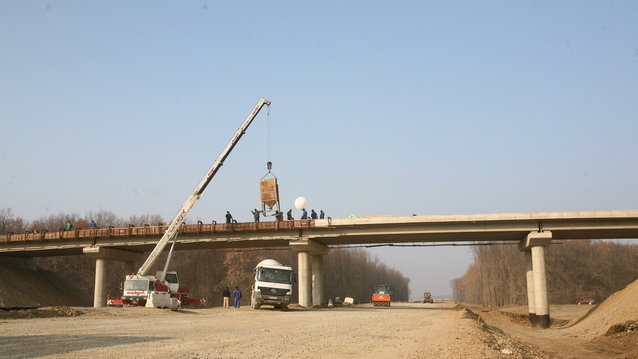

1. Termination of a highway contract with Colas
For the first time the Transport Ministry through the National Highway and Road Company (CNADNR) terminated a major contract with a construction company it accused of being behind schedule.
The EUR224 million contract with French company Colas, which was building the Cernavoda-Medgidia highway segment (20 km) was terminated in spring, after Colas had won the auction in the autumn of 2008. Minister Anca Boagiu accused Colas of also asking for the value of the contract to be increased by EUR16 million because the route had to be changed over a 14-km stretch.
Subsequently the highway section was auctioned off again, and the contract was won by Italy’s Astaldi and Germany’s Max Boegl for EUR120 million.
2. EUR2B contracts for highways, county and local roads
This year, the Transport Ministry awarded contracts of around EUR1 billion for the construction of 183 km of highways, as part of Paneuropean Corridor IV. These roads will be 85% financed with EU funds and 15% by the Romanian government. The Development Ministry also awarded 8 contracts for the rehabilitation of county and local roads, worth 4.3 billion lei (around EUR1 billion). The works are part of the National Infrastructure Development Program, the largest public infrastructure investment program conducted in Romania in the last 20 years. The main difference between this program and other state-funded infrastructure works is that the state will refund the constructors only starting in 2013, so constructors that have already been awarded contracts will have to find their own sources of financing.
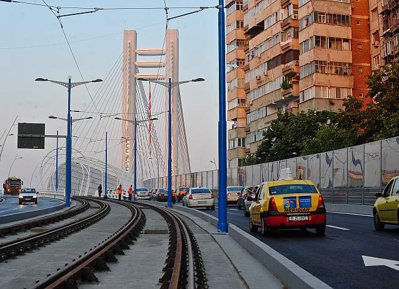 3. Inauguration of Basarab overpass
The urban infrastructure project with the biggest political importance, was inaugurated in June, after five years since works started, and cost EUR240 million. Announced back when Traian Basescu was mayor of Bucharest, started during Adriean Videanu’s tenure and completed during Sorin Oprescu’s, the Basarab overpass is the most expensive urban infrastructure project in Bucharest and one of the most complex above-ground projects.
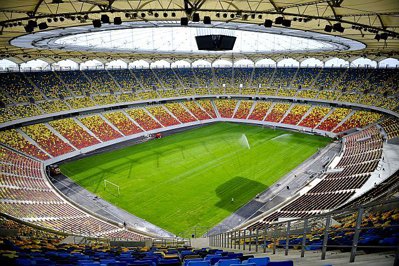
4. Two new stadiums, in Bucharest and Cluj
The year 2011 came with not one, but two modern stadiums, one in Bucharest and one in Cluj. Bucharest’s National Arena, a EUR200 million project, was inaugurated in early August, and, despite the fact that the turf on the pitch broke into tens of chunks during the first match held there between Romania and France, which cast a shadow over the first match, this is one of the most important and modern infrastructure projects in Bucharest in the past 20 years. Stadium Cluj Arena was also inaugurated this autumn, following a EUR35 million investment.
5. Timisoara-Arad highway
The most important highway inauguration this year is the 32-km long Timisoara-Arad section. Although this highway will open for traffic in December, works will be finalized only next year, when the maintenance and coordination center and the service space platform, located outside the highway, will be finalized.
The constructors of the highway, Spain’s FCC Construccion and Italy’s Astaldi, had collected around EUR85 million of the overall EUR115 million contract. This is the most important highway inauguration this year.
6. A Cernavoda bridge, opened ahead schedule
The National Highways and National Roads Company in Romania announced at the end of November that traffic was set to be resumed on DN 22C Cernavoda-Basarabi for all categories of vehicles, considering that rehabilitation works for the bridge and for viaducts above Cernavoda waterway had been finalized.
This is the first time in the last few years that an infrastructure project of this kind has been finalized 14 months ahead of the deadline. The company that handled the rehabilitation work, Arcada Company, got EUR9.5 million for this contract, which is 65.9% financed by the EBRD, while the rest of the money comes from the Romanian government.
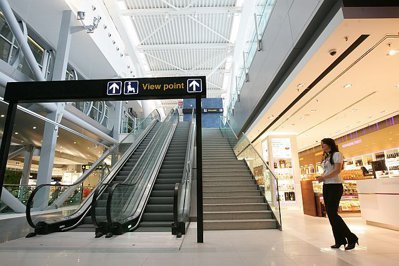 7. Henri Coanda Airport has a new terminal
The new terminal of Henri Coanda International Airport, which became operational at the end of March, added 15 boarding gates to the 9 of the old terminal, and 9 footbridges to the 5 old ones.
The project, started in August 2009, entailed an investment of around EUR60 million, with representatives of Compania Nationala Aeroporturi Bucuresti estimating it will recoup the invested money in ten years’ time.
8. Bechtel left with just two sections
Anca Boagiu, the current Transport Minister, announced this summer that Bechtel will continue works only on Campia Turzii-Gilau and Suplacu de Barcau-Bors highway sections, which account for 118 km of the 415 km of Transilvania highway, with the state being free to auction off the other six sections. The cost of building the Transilvania highway will as a result be cut by around 50%, to EUR6.9 million/km, according to the minister.
9. First subway line started after 1989
The year 2011 came with good news for the Bucharest subway, as well. Two new subway stations were inaugurated (Jiului and Parc Bazilescu) and works started on the first underground line started after the 1989 revolution, line 5. The contract for building line 5 Raul Doamnei-Eroilor, worth EUR215 million, was won this year by the consortium formed of Astaldi (Italy), FCC Construction (Spain), Delta ACM 93 (Romania) and AB Construct (Romania).
10. First railway contracts with EU funds
A first for the last eight years: State-controlled railway company CFR SA awarded the first railway rehabilitation contracts financed preponderantly with EU funds. Among the first few contracts were the ones for the rehabilitation of the Vintu de Jos-Simeria section (44 km), for nearly EUR320 million, and for the rehabilitation of the Frontier – Curtici Arad section for nearly EUR250 million. Both investments will be 85% financed with money from the European Commission, with the rest of the money to come from the state budget.
(English version by Daniela Stoican)