
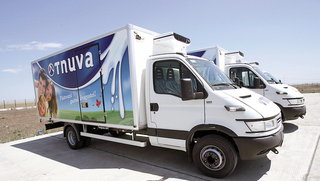

The Israeli company is now asking for EUR16.39 million, after it paid EUR55 million to enter the market. The EUR55 million was largely the investment in the plant in Popesti-Leordeni (close to Bucharest) and the money for developing a cattle farm in Adunatii-Copaceni (Giurgiu county). The decision to sell the plant comes after the around 1,000 cattle still left in the Adunatii Copaceni farm and the livestock fodder were auctioned off in mid March for an asking price of EUR2.7 million. Tnuva’s exit from Romania is one of the most resounding failures in the dairy industry.
Plant for sale
According to an announcement by Capital Insol, the judicial liquidator of Tnuva Romania, on August 6 at 12 at the headquarters of the company in Popesti Leordeni, there will be an outcry auction to sell the buildings, the storage facility, the production facility, the offices and the plot.
According to the announcement, the paperwork for joining the auction must be submitted by August 3 at the HQ of the judicial liquidator. Representatives of Capital Insol could not be contacted for more details.
Tnuva basically puts up for sale its entire investment in Romania after the company’s evolution on the local market has been far from original objectives.
Early day plans
At the end of 2005, Tnuva made a huge bet on the Romanian market, investing EUR55 million in a production facility in Romania, in Popesti-Leordeni, and in a cow farm in Adunatii-Copaceni. The company set out to achieve a business of EUR70 million within a few years from opening the facility, the shareholders aimed for a top-three position on the market and invested millions of euros in advertising, but at the end of 2011 alone Tnuva had losses of EUR17.7 million.
The performance of the dairy market was not favorable to Tnuva, either. According to the latest data, the fresh dairy market rose 4% in value last year because of price increases, but the volume of sales stagnated. The market was worth EUR266 million, sour cream sales included.
Last year Tnuva’s turnover in Romania reached EUR17.4 million. While sales were slightly up on 2010, losses deepened to EUR17.7 million from EUR15.2 million in 2010. In 2011 Tnuva’s Romanian plant had 160 employees left.
Several commercial banks financed Tnuva’s investment in Romania, among which BRD Groupe Societe Generale, Banca Romaneasca, a member of the National Bank of Greece and the National Bank of Greece. At the end of 2006 they opened a EUR25.3 million credit line for Tnuva in Romania, the only foreign country that the Israeli company had ventured into.
The European Bank for Reconstruction and Development (EBRD) also supported the company’s development plans with EUR15 million. The money was meant for building the dairy plant and for the livestock farm in Adunatii Copaceni.
(English version by Daniela Stoican)