
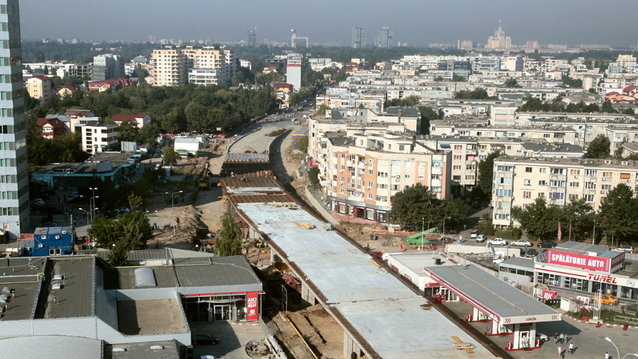
The number of cars in the city stood at about 1.17 million at the end of 2010, almost one fifth of all the vehicles registered in the entire country, according to the Driving License and Vehicle Registration Department. In other words, one in two people in Bucharest owned a car in a city where the road infrastructure continues to be a huge problem.
After only two investments that have managed to somewhat improve the traffic flow in Bucharest, i.e. the Baneasa Underpass (opened in 2009) and the Basarab Overpass (2011) in the last few years, now three more such projects are underway.
Business Construct magazine analyzed together with Madalin Dumitru, general manager of the Infrastructure Department of the Bucharest City Hall, the progress of the work on the three projects that are supposed to be completed in the coming years: the Pipera Overpass, the Mihai Bravu-Calea Vacaresti Overpass and the Buzesti-Berzei-Uranus Boulevard.
Pipera Overpass entails widening the Pipera Road and a bridge overpassing the Barbu Vacarescu Boulevard and Calea Floreasca Avenue. It should connect the future A3 highway to the city along with parallel boulevards Fabrica de Glucoza and Dimitrie Pompeiu.
The overpass will help make traffic flow fluid on Barbu Vacarescu and Calea Floreasca. The contract with PA&CO International, which is building the overpass amounted to about 120 million lei, which also included RON11 million for expropriation. The project also entailed the rehabilitation of the utilities networks, which was taken care of by the utilities providers at no cost to the City Hall.
Expropriation for the Pipera Overpass is now 100% done and the utility network relocation has been completed 80%. Work on the structural frame and carriageway are 100% and 70% done.
“We hope to have it finalized by yearend,” Dumitru says. Pipera Overpass will be 470 meters long. The total length of the project if including the widened section of the Pipera Road will be 1.5 kilometers.
The Buzesti-Berzei-Uranus Boulevard connects the north and south of the city. It will be 12.5 kilometers long, going from Piata Victoriei, through Buzesti, Berzei, Mircea Vulcanescu streets, Calea Plevnei avenue, Vasile Parvan street to the Hasdeu Bridge and then on close to Piata Cosbuc, Tudor Vladimirescu Boulevard, Calea Rahovei to Piata Progresul (Progresul Market).
Bucharest mayor Sorin Oprescu announced in November 2010 that Bucharest would be possible to cross from north to south in twenty minutes from Piata Victoriei to Piata Cosbuc, after completion of the Buzesti-Berzei-Uranus Boulevard. The new boulevard will have at least three or four lanes, help improve public transportation and also sanitize the area, something that was absolutely necessary. The estimated value of the investment is EUR330 million, municipality officials said at the time.
The project has run into problems over time, the biggest of which was caused by Hala Matache (Matache covered market). A series of non-governmental organizations fought the City Hall on the grounds that Hala Matache, a landmark building for Bucharest should remain where it is, despite the fact that the authorities proposed relocation to another site, as keeping it in its current location would bottleneck traffic, because the boulevard would have to be narrower in that particular spot.
The City Hall official says he cannot provide too many details about the estimated date for completion of the works. “Technically work could be completed in six months, but if taking into account that problems come up as we go, then we have new timeframes.” Traffic on the new boulevard should reach 50,000 vehicles a day.
The Mihai Bravu-Calea Vacaresti Overpass is actually a set of two separate bridges running in parallel with two lanes per way each and about 700 meters long.
The builder of the overpass, businessman Nelu Iordache’s Romstrade even hired a team of 20 or 30 Sri Lankan workers to complete the project. The first phase should be done by March 2012.