

„Debt recovery rates can be below 1% of large amounts, many years past due, and can exceed 80-90% on debts that are only a few days overdue.”
translated by Loredana Frățilă-Cristescu
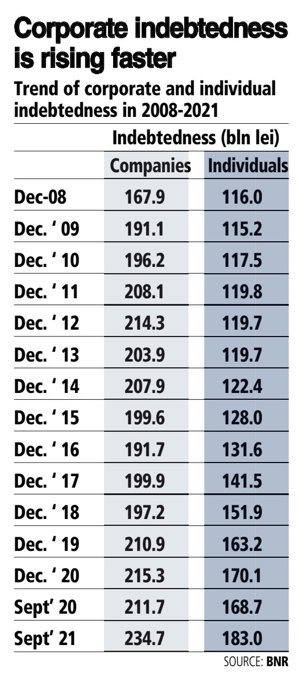
Romanians are carrying debts of more than RON180 billion, which have been growing steadily over the past 10 years; in the first nine months of 2021, the pace was +8.5%, according to the latest data Romania’s central bank (BNR) published. Adding corporate debt, the amount rises to over RON417 billion (EUR85.2 billion) at the end of September 2021, 9.8% above the September 2020 level, the fastest advance in 13 years.
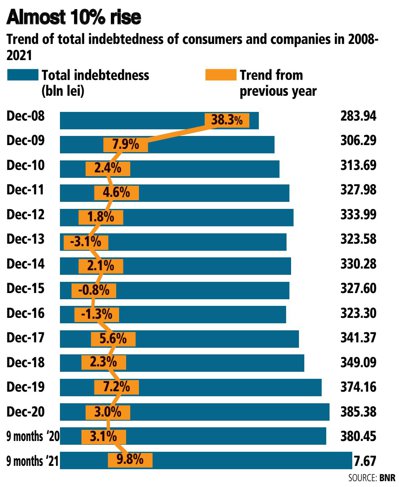 By comparison, in 2008 total indebtedness grew by about 38%, while in 2009 the speed slowed to 7.9%.
„2007, before the financial crisis, was the year when lending was booming and the average Romanian dreamed of multiplying their income by investing in land whose price was booming overnight, even in the cold season. It was a time when banks focused on selling as many loans as possible, interest rates were still high and the market was poorly regulated in terms of consumer protection. In the last 15 years, the Romanian banking market has developed a lot in terms of the transparency of the products offered. At the same time, more and more emphasis has been placed on customer financial education. A series of efforts such as the confidence of international players invested in the Romanian market, the setting of sustainable lending standards and the application of solutions to increase solvency, as well as an alignment with digitization trends represent the strengths of the local banking sector,” says Claudiu Bud, Director of Strategic Transactions Area with KRUK Romania.
The Polish company entered the local market with a portfolio of 15,000 clients in 2007 and came to manage the debt of more than 2 million Romanians in 2021. The number of clients who paid the entire debt to KRUK Romania is 538,761 and 54% of them chose the amicable solutions offered.
The local debt collection market has developed spectacularly over the last
15 years, from around RON2 billion in 2007 to over RON10 billion in some years, depending on market conditions. Today, its value has considerably reduced to RON4-5 billion. „The size of the market has varied significantly in terms of the non-performing loan ratio, with the latter peaking at 21.5% of total loans granted in 2014 and returning to a lower level in November 2021,“ Claudiu Bud said.
According to the latest data from the BNR, the NPL ratio fell to 3.47% in November 2021, the lowest level in the last decade, after the banking system ended 2020 with a rate of 3.83%. Romania’s central bank points out that, in terms of payment discipline, non-housing loans have a higher NPL rate than housing loans (4.3% compared to 1.4%).
„All these elements must also be understood in the context of the economic growth that Romania has experienced. Probably in the absence of limited deductibility, the Romanian banking system could be much better prepared for the storms on the horizon.“
But are Romanians vulnerable to accumulating debt? Daniel David, rector of the „Babeș-Bolyai“ University of Cluj-Napoca, professor and PhD in psychology, believes that Romania is fragmented between two typologies: „traditional Romanians“, who do not take out loans easily, but if they do, in the absence of discipline and advanced financial education, they do not repay them very responsibly, and „modern Romanians“, who take out loans more easily, but who, again in the absence of discipline and advanced financial education, have trouble repaying them responsibly, as well. „In general, Romanians are vulnerable to accumulating non-performing loans or not having loans at all, at the expense of a modern profile involving performing and responsible loans for development.“
 As for the reason for this behavior, the professor believes that many Romanians are in the emancipation phase, so they easily take on expenses beyond their income for the sake of welfare. „If this discrepancy were in the ‘zone of proximate development’ it would be fine, but to understand this area you need education and, above all, financial education, which is often deficient.“ In general, Romanians are cautious rather than risk takers, but this conclusion needs to be nuanced generationally and even regionally. „Statistically speaking, young people risk more for things that give them value and pleasure (pleasant life), while the other generations risk more for things that provide security and expected social status (good life).“
Rising incomes, falling unemployment, falling interest rates, the formation of a middle class and the development of an entrepreneurial segment have led to important changes in the consumer profile and the needs of an important segment of the population. Whereas in the past loans used to be taken out almost exclusively for a house or a car, now one can borrow for everything from household appliances to phones and holidays. All these changes can be both beneficial and extremely harmful.
„We can now access loans online, with low effort and therefore low awareness. I mean file, paperwork, approvals, standing in line at the bank, etc. vs. opening an app, talking to a robot or taking out the loan in the store,“ Claudiu Bud points out.
In turn, creditors have become more flexible and more concerned with the „customer care/customer experience“ area, offering new loan restructuring models, developing internal departments dedicated to prevention, changing the telephone service suspension process, or postponing disconnection of services in the utilities area.
As for the success rate in debt collection, it varies widely depending on the type of debt (utility bill, loan, leasing), on how old and how high it is. In practice, the recovery rate can be less than 1% for high value debts that are many years past due and can exceed 80-90% for debts that are only a few days overdue. „In our 15 years of activity on the Romanian market we have tried to help our clients (debtors) understand the importance of communicating with their creditor, in an attempt to find the most suitable solutions for both parties and the responsibility of each of us in relation to our debts.”
It remains to be seen how well the lessons of the past have been learned in the context of the pandemic and looming crises such as the energy crisis. In 2021, new consumer and mortgage loans accelerated to a 15-year high of RON48 billion, 41% above 2020, after lending declined in the first year of the pandemic. Last year also saw the biggest annual jump in retail lending since 2007, when BNR started publishing such data.
„Romanians continue to borrow, not only from banks but also from people close to them. It is interesting to correlate this with the reasons for default that we often encounter in conversations with clients – over-indebtedness, financial problems or delayed income are the reasons we find preponderantly, regardless of the sector of activity to which the debt we are trying to recover belongs,” the Kruk director explained. At the same time, there is a prioritization of spending, especially in the context of the pandemic, with debtors choosing to pay all utilities first, then basic utilities and then bank instalments.