
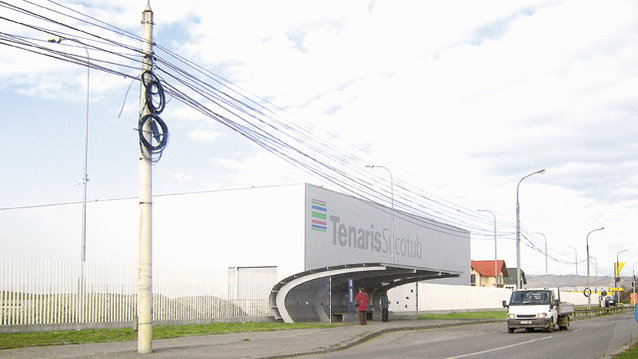
This is the first time Tenaris has outranked ArcelorMittal Galati, a unit of the world’s largest steelmaker ArcelorMittal.
The pipe manufacturing plant held by world leader Tenaris in Zalau (north-western Romania) is by far the most profitable business in the Romanian steel industry. Last year, the company, which also has a steel plant in Calarasi (south-eastern Romania), reported a net profit of EUR52 million, while the other companies in the top twenty recorded combined losses of around EUR116 million.
How has this been possible? Tenaris has invested around $160 million (about EUR120 million) in the two Romanian plants in the last three years alone and brought the plants to a level of automation and performance similar to the group’s production facilities in developed countries, such as Japan, Italy and the US. The company relies on premium products, with high added value.
Here is what the Romanian Zalau plant looks like: In the plant’s yard everything looks to be in its place and the modern look of the buildings does not offer any clue that this is a 35-ha industrial platform.
In the yard workers are building the foundation of the future Tenaris University, a $15-18 million investment. The plant’s employees will take courses here as part of continuing professional development. Nearby are the company’s labs, where it is determined what specific alloys the pipes will be made of so that they meet clients’ strict criteria.
“We want to create a pleasant environment for our employees, where they can learn and continue to develop professionally. Tenaris also has universities such as the one to be built in Romania in Italy, Mexico, Argentina and the US. They are different, but the concept is the same everywhere,” says Michele Della Briotta, Managing Director for Eastern Europe at Tenaris.
The three rolling mills in Zalau process steel billets (raw steel bars) sourced from the Tenaris group’s Calarasi plant, where they are given their original plant. At the Zalau mills everything is automated and analyzed from a control room.
“We watch a number of parameters from the control room. (…) Everything is automated. Personnel only comes in when there are problems,” says Mircea Florean, head of shift at the rolling mill.
On the production line workers are practically non-existent because the command center has cameras installed that watch the production process.
The rolling mills have a maximum capacity of 250,000 tons per year and this year they are set to make around 200,000 tons. (…)
Visitors go on to see the pipe finishing facility, where value is added. Here the company has just finalized an investment of around $50 million into premium products for the oil and gas industry. The new investment will boost capacity of the premium pipes production line from 15,000 tons per year to around 50,000 tons per year.
The new line will produce premium pipes used by oil and gas companies in challenging environments, such as offshore, deep water, corrosive, high temperature and high pressure wells.
Premium OCTG pipes are used for instance in the project to be conducted by OMV Petrom (SNP.RO) and ExxonMobil in the Romanian section of the Black Sea, where the two companies made a significant gas discovery last year.
“OMV Petrom, ENI, Shell, Exxon, Chevron, Lukoil, we will be working with all of them,” Michele Della Briotta says.
The new production line will go through a qualification round and the executive expects it to qualify for all major companies in the oil and gas sector. He says some of them have already placed orders without inspecting the new production line.
“We believe this line should firstly cater to demand in this area of Europe – Kazakhstan, Russia, Romania, Middle East, the eastern part of the Mediterranean region.”
He explains the company is also making pipes for the US at the Zalau plant, but that it would be logical for the company to serve the area he mentioned because it has a price advantage thanks to lower transportation costs. In the company’s premium pipe finishing facility there are around 10 employees, most of whom are supervising the fully automated production process from the control board.
Tenaris has around 1,600 employees in Romania, about 1,100 of whom work at the Zalau plant, but many are involved in the company’s sale and distribution activities, as well as in other support services.
Last year the profit of Tenaris Silcotub (which includes the Zalau and Calarasi plants) doubled, to 231 million lei (EUR52 million) and the company’s turnover climbed 15.5% to RON1.66 billion (EUR375 million). The pipe manufacturer is one of Romania’s largest exporters, with around 80% of production going abroad.
The steel plant in Calarasi in turn exports around half its production of steel billets to a plant of the group in North America whose orders are on the rise.
Although the company is affected by the high energy prices because of additional costs being included in the price (renewable energy costs and cogeneration taxes), Tenaris has not conditioned further investments on relieving the burden of energy costs and on other incentives from the government, as other companies in the sector have done.
“I believe the Romanian market is very interesting because we have Petrom and Romgaz here, our main clients, and new ones coming to Romania, such as Chevron, which wants to explore shale gas close to the Black Sea. (…) We are very optimistic about Romania, that is why we are investing here,” concludes Michele Della Briotta.
(English version by Daniela Stoican)