
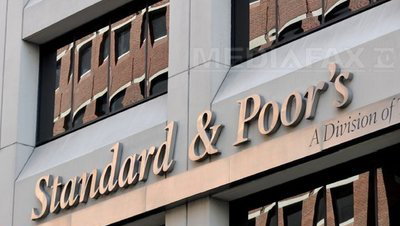
S&P has taken the most severe stance, keeping Romania outside the investment grade category, although the country’s CDS (the cost of insuring against the risk of default) has for some time fallen below 200 basis points. Currently it is at 180 points, below Turkey, Hungary and Croatia.
Why are the Romanian authorities not able to persuade rating agencies that Romania deserves a better rating? And why don’t rating agencies believe in the overly positive evaluations of the IMF?
Last month, on a visit to Washington for the autumn meeting of the IMF and the World Bank, Romanian Budget Minister Liviu Voinea invited S&P analysts, including the head of the sovereign ratings department for talks, and presented Romania’s economic performance to them.
He sought to get S&P to at least change the country’s rating outlook, if not to include the country in the investment grade category.
The S&P rating has not changed since the autumn of 2008, when the black clouds of crisis were gathering. At the time Romania was removed from the category of low-risk countries, which it had entered in 2005. Since then the country risk grade has remained at BB+, with a stable outlook. The agency’s analysts have apparently not been impressed by Minister Voinea’s presentation.
Banking sources say the US agency has not emerged untouched by the scandals that have surrounded it in the past few years. The agency does not challenge the fact that Romania is macroeconomically stable, but calls Romania’s business environment unfriendly.
An unfriendly business environment has a negative impact on the economic growth potential – as proof, the real economy is stagnating rather than growing, being influenced mainly by circumstantial factors.
In other words, figures to do with inflation and the budget deficit are not enough to persuade S&P. The rating agency is waiting to see a solid economic growth trend.
S&P is also pointing a finger at the corporate governance problems in state-run companies and at the failed privatizations, so analysts are not impressed by fiscal consolidation.
Romania is evaluated as stable, but on the brink of stagnation. There is clearly no danger of a downgrade of the rating outlook or of the rating itself, but it is just as clear that a rating upgrade will not come soon, either.
The Romanian Government hopes that in spring, if it gets positive evaluations on the program negotiated with the IMF and the European Commission, it will get a positive rating outlook from S&P and subsequently an upgrade.
“There is no longer a direct connection between the assessment made by the markets and country ratings. The BB+ rating from Standard&Poor’s stands out in contrast with the ratings of the other two major agencies,” comments Gianluca Salsecci, Head of the International Economics Office at Intesa Sanpaolo.
“I would expect S&P to improve its rating as the program with the IMF advances. What is certain is that the market has a better opinion because spreads for Romania are lower even than for some countries in the eurozone,” he adds.
He believes S&P cannot bring Romania back into the group of investment grade countries because the country could have a hard time meeting its external financial obligations unless it can roll over at least 50% of its external debts.
In the early 2000s rating agencies were much more active in updating their evaluations on Romania, changing the country’s rating as often as twice a year between 2001 and 2004, when the country’s government was also guided by the IMF.
But during the booming period that followed Romania did not manage to progress to investment grade. It remained somewhere on the edge and was promptly downgraded when the crisis came.
With the exception of Moody’s rating, Romania continues to have poorer ratings from the other two agencies than in 2007, the year when the country joined the European Union.
(English version by Daniela Stoican)