
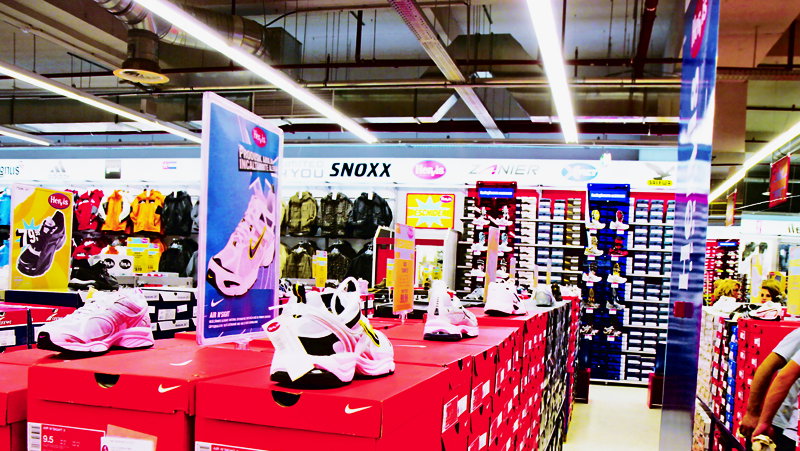
As with the grocery retail, the main sporting goods retailers have built a business model more or less around the price, and therefore around private labels as a percentage of the total business. Decathlon is the ‘discounter’ of the market, as it emphasizes low prices.
Its stores range from 1,000 to 5,000 square meters and carry products for 50 to 90 sports. Usually located on the outskirts of the cities to avoid paying the high rent that comes with a central location, Decathlon’s prices are similar to those in bazaars or hypermarkets, chief executive officer Eric Mazillier said.
Decathlon group sells more than 50,000 products, developed in France and then manufactured by suppliers all over the world, he added. Decathlon has partners making bicycles, leather footwear and clothing in Romania.
“When we open a new store, we seek a large enough space to be able to carry products for at least 50 sports (although there may be as many as 90),” Mazillier said about a month ago, adding that the company also looked for a position that allows it to charge low prices.
Moreover, Decathlon’s CEO says that in the past three years since his arrival in Romania his target has been cut prices by 20% on average. This move may affect the bottom line but does gain customers, he admits, and Decathlon does not focus on high income customers only, but also on those with average and low incomes.
Grocery retailer Lidl uses the same business model, as about 80% of the products it sells are private label products and it focuses on price.
In comparison, up to 20% or 30% of the products a supermarket or hypermarket sells are private label products. Their contribution to revenue is similar. This is the business model sporting goods retailer Hervis uses. Hervis has 15 stores in Romania and posted 84 million lei (EUR19 million) revenue last year.
“The private labels, such as Kilimanjaro, Cygnus, and X-Fact contribute about 20% of the revenue. I don’t think we can compare business models in sport [ing goods] and food [retail], because private labels are more important in the latter’s case,” says Catalin Pozdarie, the executive who runs Hervis.
Whereas Decathlon has a similar price-focused business model to Lidl, and Hervis can be compared to a hypermarket, Greek-held Intersport is more like Mega Image, as neither of the two focuses on price only.
Intersport introduced private labels as late as two years ago, when a survey commissioned to GfK showed customers saw it as an expensive retailer. They said Intersport did not have any promotional offers and prices were high, which is why the company decided to introduce first price products in its stores.
This is the second year such products have been available in Intersport stores and they already generate 8% of the revenue. The business model remained unchanged, with a focus on brand name products, because price may be important but not the most important in the decision to purchase sporting goods, Antoniu Nituleasa, chief executive officer of Intersport Romania believes. The most important things for a consumer are the comfort and performance the product they purchase offers.
(English version by Loredana Fratila-Cristescu)