

Right in the middle of one of the fanciest areas of Bucharest, in the Floreasca neighborhood, Luiza Rudeanu comes to work daily. Her workplace is the business she set up, which she has been running in the past two years.
A shop of delicacies brought from Portugal, which is seeking to consolidate its place on a market that lacks clear outlines and is extremely volatile. Her decision to open such a business was strictly emotional – she has a soft spot for Portugal and Portuguese gastronomy, which she acquired after spending a vacation there. But things happened faster than she could have ever imagined, writes Business Magazin magazine.
“The idea of bringing to Romania the products that I had fallen in love with in Portugal was tempting, but I didn’t know what I needed, how this whole project would go, so, for starters, I phoned a producer whose number I found on the label of a sardine can I had bought during my holiday,” recalls Rudeanu, owner of the Gala Food delicacy store.
The producer invited her to go to Portugal and discuss more extensively about what Portuguese gastronomy really means and what she could import to Romania.
There, he introduced her to small local producers, from whom she could buy everything she needed in order to build a complex portfolio. “During those days, when I visited tens of small gourmet stores, I truly fell in love with the Portuguese cuisine. So I came back to Romania with the famous tomato, orange, almond jam, fish pate, sardines, olive oil and, of course, wine. This was part of her first stock of merchandise.
The rest were details, which she ticked off quickly. “I resigned from the company where I was working as a finance specialist and I found a space which I rented and renovated pretty quickly,” explains the businesswoman.
The initial investment amounted to around EUR20,000, with half the amount covering renovation of the space and half the purchase of the first stock of merchandise. She had big plans from the very start, and opened two stores – one with culinary products and one with textiles, she even wanted at some point to go into distribution to big store chains, but the market was not that open and she had to limit her expectations.
Now she has one single store and a wine bar where Portuguese wine buffs can taste and buy the products. Her strategy has been simple – building a base of loyal customers whose tastes she tried to become familiar with, and who would come to the store every week.
“They are people who travelled a lot and who like gourmet food. Out of all of them, only six or seven are Portuguese families, the rest are Romanians,” says Luiza Rudeanu. The best-selling products in her store are fish cans and wines, followed by goat cheese and olive oil.
The average cash receipt is 100 lei (EUR23) but there are also customers who buy record amounts. I had a customer who once bought 160 jars of jam in one go,” says the owner of Gala Food.
Prices are not necessarily prohibitive – a jar of jam costs around RON20, while goat or sheep cheese costs around RON70 per kilo, and these are among the highest prices.
The most expensive bottle of wine of the over 50 available costs RON235. Rudeanu has merchandise worth EUR40,000-50,000 per week at all times and she gets new supplies weekly, which is “extremely costly”, as she herself puts it.
Rudeanu seldom has a profit margin of more than 10% per year, which, at a turnover of EUR100,000 per year, is not very much.
“Every month I think about closing down the business, but I always find a reason to continue because I like very much what I do,” says Luiza Rudeanu.
Also out of a passion for food, Giorgio Capiali opened his own business in the food business, a “salsamenteria” in northern Bucharest. This is a restaurant with a store with specialized products attached.
This is not the first business on the Romanian market for Capiali, who also has a footwear store chain – Nexus, which in the last few years no longer performed as well as before, and became a secondary source of revenue.
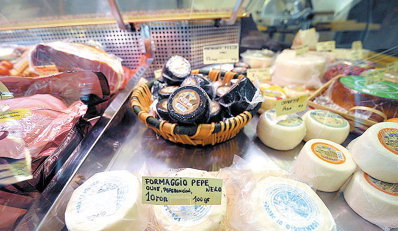 Now Salsamente Pipera is his main focus. He handled the renovation of the space since the beginning, came up with the menu, he handles the relationship with the producers and once every two weeks goes to Italy to get the necessary supplies.
Unlike Luiza Rudeanu’s delicacy shop, Capiali’s shop is lucky enough to have the support of the restaurant, which in fact generates 70% of the turnover.
In addition, Italian cuisine is much better known to Romanians, with Bucharest being home to many Italian restaurants, although Capiali says very few use original recipes and products sourced from Italy.
“Already Romanians have started to refine their taste. For instance, they no longer ask for ketchup with their pizza, as they used to earlier,” says the owner of Salsamenteria Pipera.
Customers tend to buy prosciutto crudo and parmesan, which have gained favor with Romanians. Mozzarella and olive oil are also among Romanians’ favorites, and the average cash receipt does not exceed RON50.
The Italian sells around EUR10,000 worth of products to Romanians, which, added to the restaurant revenues, has helped him to recoup the EUR150,000 investment in the business.
Now he is looking to open a salsamenteria in central Bucharest, but wants to avoid the historic center at all costs, which he sees as lacking identity and as a place where his business could get lost in the crowd.
(English version by Daniela Stoican)