
In turn Bruno Ribo, the general manager of ArcelorMittal Galati, the largest steel mill and the second largest electricity consumer in the country, said that only 5% of the components of the 800 wind turbines installed in Romania so far had been manufactured locally.
Therefore Bruno Ribo says the green power, a sector that has attracted more than EUR3 billion in investment in the last three years, has turned into a burden for his company, which has to pay more for power while getting nothing in return in terms of business.
On the other hand, Petru Ruset, head of the energy division of Siemens Romania, said during the ZF Power Summit ’13 held on February 27 and February 28, that his company buys steel from ArcelorMittal Galati. The steel is used to make wind turbine towers in plants outside Romania and brought back to be installed in the wind farms in this country.
Even so, European statistics show that 75% to 80% of the investment in a wind farm is spent on turbines and rest goes to foundation work, electrical installations and necessary surveys.
Surveys are about the only thing Romanian-made because the local authorities have not put any conditions in place requiring investors to use local components in their renewable power investment in exchange for coverage by the support scheme, and thus helping a local industry of such products develop.
The Siemens boss, however, believes that if the scheme were to distinguish between investors, the local market would stand to gain more.
“Maybe a change of legislation and renewable energy generation scheme could help improve this market somewhat. The scheme can be designed so as to treat producers that do not use locally-manufactured components and producers that do differently,” Costache says.
“If it becomes interesting enough for the local players, financially speaking, things could improve for the local industry, too.”
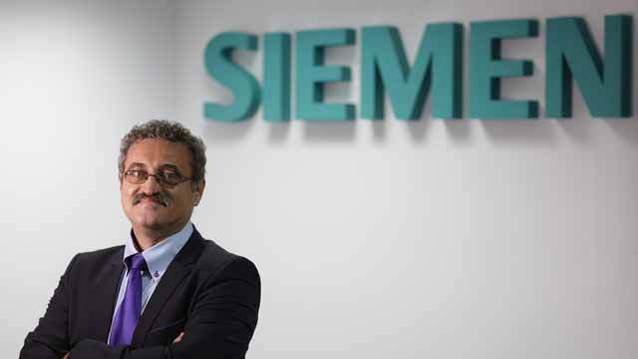
Siemens Romania’s general manager says his company is looking for suppliers of components for the wind turbines it installs in Romania.
“There are quite a number of suppliers with solid references that could supply components up to the customers’ standards.”
Siemens has several partnerships with local companies. One of the partners is railway carriage manufacturer Astra Vagoane Calatori Arad, owned by businessman Valer Blidar, which makes low-floor trams, supervised by Siemens.
Siemens’ local operations generate about EUR300 million revenue from four main sectors: industry, energy, healthcare and infrastructure.
“Siemens Romania had a good year despite the difficult market. We saw stable growth across all four sectors last year,” Siemens Romania’s general manager said.
“We are optimistic this year and would like to at least see the same growth as last year, if the recently announced governmental strategies to absorb European funds are applied,” the Siemens official concluded.
(English version by Loredana Fratila-Cristescu)