
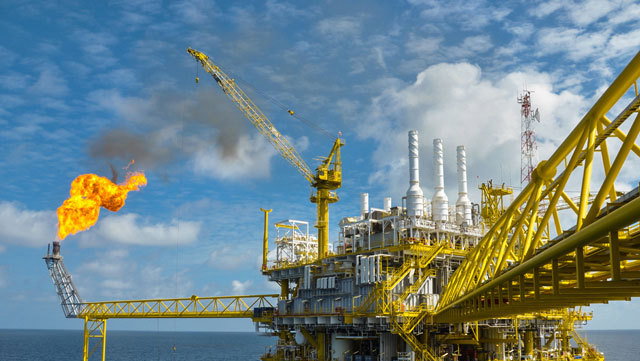
Under the circumstances, Romgaz has to step up exploration and production efforts, even if this means drilling deeper and deeper, taking the chances of Black Sea operations or shale gas. Or else it will lose the top spot to rival OMV Petrom (SNP.RO).
Whereas Romgaz’s production stood at 6.98 billion cubic meters of natural gas in 2003, by 2012 it merely reached 5.6 billion cubic meters, and 2013 was probably another year of production decline.
The production of Romania’s most valuable state-owned asset, Romgaz, declined by almost 20% in the past decade.
“Analyzing the data, we can see (…) the annual production decline in 2008-2012 was much lower compared with the previous period (2003-2008), of 0.8% from 3.3% in 2003-2008. The 2013 data are not publicly available yet and will be released according to the reporting schedule,” Romgaz officials say.
Romgaz is not the only company experiencing production decline, considering the oil&gas industry has an over 100-year tradition in Romania.
Whereas in 2004, the year of Petrom’s (SNP.RO) privatization, for instance, its total production stood at 81.3 million barrels of oil equivalent (boe), the producer currently owned by Austria’s OMV, drilled 62.4 million boe in 2012, even tough most of Petrom’s investment goes towards exploration and production.
The good news for Petrom, at least, is that after all its investments, 2013 could be the first year after privatization when production went up slightly. Moreover, Petrom has already announced that along with its partner, ExxonMobil, it identified a gas deposit worth $25 billion in the Black Sea, which could fuel Romania for four years on its own, according to ZF’s calculations based on market data.
The National Agency for Mineral Resources (ANRM) last year said it planned to auction 36 new exploration and production blocks, eight of which in the Black Sea.
Romgaz officials admit that maritime drilling can turn up potential resources likely to offset the natural decline of the mature on-shore deposits, but Romgaz does not have any block in the Black Sea, only a few minority interests in projects controlled by other companies.
It shares a block with Petrom and ExxonMobil, for instance, for which it signed a contract for an option to buy 10% in it. The block has very good prospects and is close to the Neptun Block of Petrom and ExxonMobil, where the two have already reported a discovery. Romgaz can exert its option to buy in case of a commercially viable discovery, its officials said.
Romgaz also has a minority stake in a Black Sea block controlled by Lukoil, which has not announced any details about its offshore investment plans.
Romgaz had proven natural gas reserves of 62.1 billion cubic meters on June 30, 2013, enough to cover 11 years of production and probable reserves of 13.2 billion cubic meters or two or three more years of production. Possible reserves, which are most uncertain of all, stand at 11.8 billion cubic meters.
“Romgaz intends to continue geological surveys in view of new natural gas deposit discovery,” its officials said, adding projects started in previous years would continue. They did not specify a budget or a clear project schedule for this year.
Romgaz’s net profit dropped 55% to 410.6 million lei (EUR91 million) in the first nine months of 2013 from RON917.6 million in the same time in 2012. Turnover fell 10% to RON2.587 billion in the first nine months of 2013 from the RON2.873 billion in the corresponding period of the previous year. (EUR1=RON4.5101)
(English version by Loredana Fratila-Cristescu)