
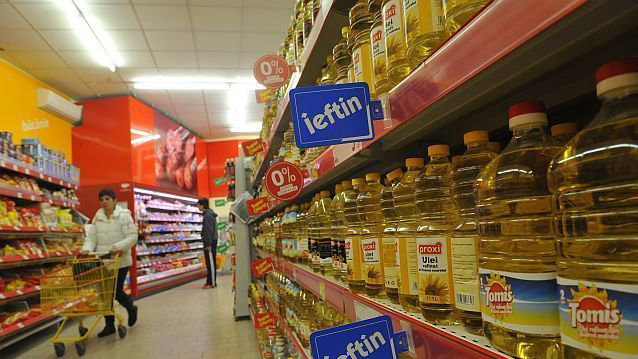
More and more people are buying Aro, 365 and K-Classic private label products, after the crisis made them use price as the main factor when deciding to buy something. Whereas Romanians would look for brand name products in 2004-2005 and private labels accounted for 1% of local retail, the latter reached 12% at the end of 2012.
Romania is one of the markets where private labels are rising fast, having gone up from 9% to 12% last year.
Local retail, which includes the results of both foreign networks and small local merchants, is estimated at EUR15 billion to EUR16 billion, which means Romanians spent EUR1.8 billion to EUR1.9 billion on private label products.
After having conquered less visible market segments, such as paper tissues and spices, private labels are now taking on the main segments of the consumer goods market. They have made it among the best-selling brands on previously brand-name product dominated segments such as yogurt, milk, soap and toothpaste.
The trend will become even more visible in the coming years, as Romania is far behind countries like Austria and Slovakia, where one in three products purchased is a private label product.
Moreover, people in Western countries tend to buy looking at the price first, regardless of the state of their respective economies.
“It is difficult to estimate how much (of our total sales i.e.) private label products will account for in 2013, but we can say the number of such products is rising,” Lidl official said.
More than 80% of the products Lidl sells are private label products and the company is constantly developing new ones working with both Romanian and international suppliers, Lidl representatives added.
The German-held retailer introduced a different business model in Romania when it arrived in 2011, i.e. selling mostly private label products, while stocking brand name products only by request.
On the other hand, Lidl’s direct competitor, discount store chain Penny Market, relies on brand names for most of its sales, with private label products only accounting for 30%. Lidl would not reveal how much of its revenue private labels generate, but according to ZF calculations, the percentage is the same as with product portfolio, more than 80%.
Discount store chains are those selling mostly private label products, which account for only 10% to 15% of the sales of supermarkets and hypermarkets. The exception to the rule is market leader Kaufland, which however, operates discount hypermarkets.
“Billa Romania has several types of private labels covering all the customers’ needs. Billa’s private labels currently account for 11.5% of sales and considering the new consumer trends, we will see a slight growth by the end of 2013,” says Sorana Georgia, chief executive of the retail chain.
(English version by Loredana Fratila-Cristescu)