
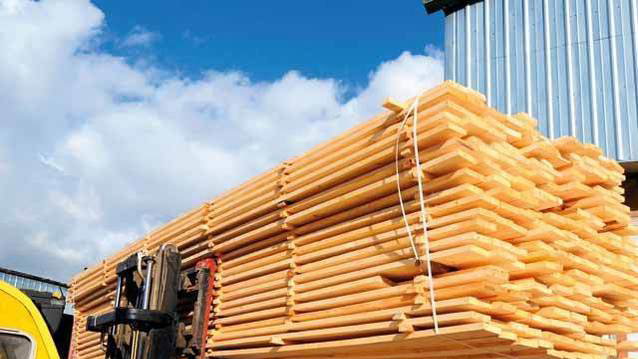
Growth should mainly come from exports, from non-European markets and less from the domestic market, where the construction and furniture sectors are trying to offset the decline.
Exports, after all, kept these companies going during the crisis and helped them make new investments. Even Romsilva, the company in charge of the government’s forests conducted exports in 2012, when it sold wood and forest berries abroad.
On the other hand, Turkey’s Kastamonu, which owns the former Prolemn in Reghin (central to northern Romania), completed a particleboard plant.
Few industries in the Romanian economy can boast such results in the last few years, which means the overall trend is to keep the business as it is.
Some in the wood industry are saying for the first time that the growth will run out of steam in the next few years, once the maximum export potential of Romania’s forests is reached.
Better than in Europe
“It was a successful year,” says Austrian businessman Gerald Schweighofer unhesitatingly. He owns the largest local wood processing operation and what he means is that the business in Romania went well and generated half a billion euro revenue.
This makes it the first company in its industry to see such revenue. Things were bad in Europe, on the other hand.
The wood market was horrible in Europe in 2012; the operations in Austria are connected to the operations in Italy, and Italy was a disaster, Gerald Schweighofer said adding this year would be even worse.
There is a paradox on the European market, the Austrian businessman says. Forest owners are putting up less and less wood for sale, yet the price remains very low. Why is this?
The slow construction market and therefore the low consumption on this market, he answers.
The products he makes in Romania go to Japan, his main export market, because it offers the best prices, which means the businessman did not feel the local turmoil that much.
How good the prices Schweighofer is getting from the Japanese market are can be seen in the gap between the volume and the value of the exports to this country. Exports to Japan account for one quarter of the volume and for 40% of the value.
The construction sector is down everywhere in Europe and even some exporting countries are not doing well, either. That is the case in Western Europe, in Northern Africa. The politician crisis was a problem, too, in many areas, Schweighofer said.
The businessman returned to the US market last year but says construction and demand remain low there, as well, even though he got his products in stores of the world’s largest do-it-yourself retail chain, Home Depot.
Gerald Schweighofer started his Romanian business twelve years ago and now has the largest wood processing operations in the country. He opened his first saw mill in Sebes, Alba County, ten years ago, in 2008 completed another saw mill in Radauti and in the same year took over an edge glued panel plant in Siret. In 2009, he bought a plant in Comanesti, which makes products for sale in DIY stores. He also owns 16,000 hectares of forest, as well as farmland and a hotel in Radauti (northern Romania).
The Austrian businessman says he is not interested in buying more land, because it is “too complicated.”
Exporting forest berries
Romsilva, the company managing the state-owned forests, lost the top position among wood industry companies two years ago. It still can sway the entire industry with its decisions, though. Romsilva posted 1.24 billion lei (EUR281 million) revenue last year, the same as in 2011, but gross profit doubled to RON75 million, from the almost RON30 million of 2011, according to Mediafax.
Romsilva’s general manager Adam Craciunescu says that sale of wood generated most (77%) of last year’s revenue. About of EUR5 million of its revenue came from export of hunting services, forest berries and wood.
The company has been using the same business model for twenty years, i.e. logging. It manages 3.4 million hectares of forest held by the government via the Finance Ministry and 1.1 million hectares held by the local authorities and various individuals.
Continuing investment
Holzindustrie is not the only Austrian-held company with a strong presence in Romania’s wood industry. Kronospan and Egger, too, have processing facilities in this country and continued to invest over the last few years.
“Egger continued development plans for the plant in Radauti so as to turn it into an fully integrated production facility. The company started the legal steps to secure the necessary permits to build a power plant running on biomass on the industrial site in Radauti,” says Ioan Banciu, technical manager of the Egger plant in Radauti.
Egger is the latest arrival on the Romanian wood processing market, after having invested EUR210 million in Radauti in facility that mainly makes particleboard in 2008. It posted EUR140 million revenue in Romania in 2011.
“Exports had significant contribution to the revenue of Egger Romania again. The Egger plant in Radauti exports about two thirds of its products, OSB (oriented strand board i.e.) and raw and melamine-faced particleboard to neighboring markets in Eastern Europe,” Ioan Banciu said.
He expects exports to generate as much of the revenue as before this year.
“Most of Egger Romania’s current production goes to Eastern and Southern Europe, to the Middle East, the Baltic countries and the CIS, 29 countries in all.”
Wooden houses are becoming more and more attractive in this part of Europe, for environmental reasons, a trend Egger hopes to see growth from.
Another Austrian-held group in the wood-processing business in Romania is Kronospan. The group expected the revenue to increase 12% in 2012 from the EUR300 million of 2011. Kronospan has plants in Brasov and Sebes and also owns Kronospan Sepal, which leases equipment and machinery.
Kronospan makes raw and melamine-faced particleboard and MDF (medium density fiberboard) in Sebes and OSB for use in the construction industry and particleboard for the furniture industry in Brasov.
A new player
Last summer, Turkey’s Kastamonu completed a EUR150 million investment in a particleboard plant in Reghin, whose capacity stands at 500,000 cubic meters a year. With the investment completed, Kastamonu expects more than EUR100 million revenue this year.
Kastamonu Romania makes HDF (high-density fiberboard) for doors, door skins, door slabs and modular doors, as well as raw and melamine-faced particleboard.
It exports to more than 30 countries, among which Turkey, Ukraine, France and the Northern African countries.
National Statistics Institute data show Romania ‘harvested’ 18.7 million cubic meters of wood in 2011, most of which went to various countries all over the world. (EUR1=RON4.4098)
(English version by Loredana Fratila-Cristescu)