
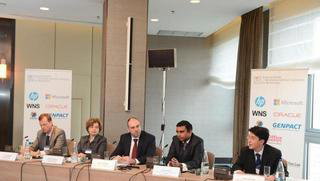
That is why major players on this market–HP, Wipro, Genpact, Oracle, Microsoft and WNS–have set up an association to act in their interest.
“We set up this association because we want our industry to be better represented and better defined. We don’t have a CAEN code [NACE code corresponding to economic activities], we are forced to register the companies under different names, such as IT services. Although work legislation has been modified, the Labor Code has not been adjusted to suit our requirements, although in our industry people are the main asset,” said Vivek Bakshi, the Indian executive who runs the local and European operations of business process outsourcing provider BPO Wipro, with 1,000 employees in Bucharest and Timisoara. Wipro is one of the first member companies of the Association of Business Solutions Leaders (ABSL).
At a net average salary of EUE400 per month paid to employees, the local industry of outsourcing services contributes almost EUR200 million per year to the economy, with the money going into consumption and taxes to the state budget.
“The local market has a significant growth potential, we estimate the number of employees in the industry could rise by 10-20% a year, at the same rate as it has done in the past few years,” believes Alexander Weigl, managing director of HP GeBOC (Global eBusiness Operation Center) Romania, the IT consultancy and services center of US company Hewlett-Packard, which has over 3,100 employees in Romania.
Weigl, who has been running the operations of HP’s local center since 2010, is president of the Association of Business Services Leaders in Romania, which has been set up in order to increase visibility of these service centers, to attract qualified candidates to this field, improve university curricula, as well as improve collaboration with the authorities. So far, members of ABSL include companies such as Genpact, HP, Microsoft, Office Depot, Oracle, Petrom, Wipro and WNS.
According to Vivek Bakshi, Romania can become a European “hub” as far as services are concerned, despite the Polish market being more mature, with 80,000 employees working in the sector.
“Romania’s main advantage is that a lot of Romanians speak different foreign languages. With a little help from the authorities to develop the business environment, there’s no reason why Romania shouldn’t be no. 1 in Europe in terms of outsourcing services, Bakshi says.
(English version by Daniela Stoican)