
The protests could have a deep economic impact, affect the leu’s exchange rate, the stock exchange, financing costs and even consumption because people could decide to put off the acquisition of durable goods for fear of escalating violence and of possible damage.
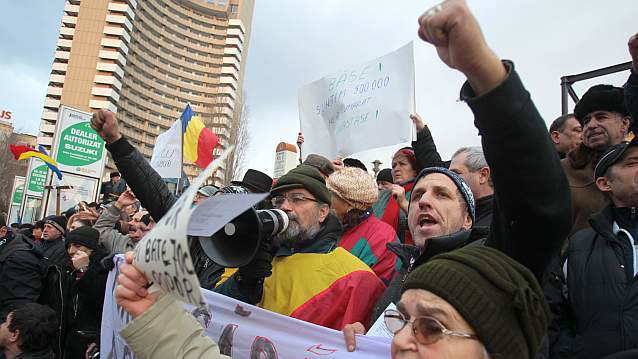
The protests are the result of simmering social tensions, with Romanians having had to swallow bitter pills during the economic crisis, in the form of VAT hikes and of wage cuts. Sunday’s demonstrations span 41 cities, were attended by over 8,700 people, according to officials of the Gendarmerie, and only turned violent in Bucharest.
In the center of Bucharest, damages amounted to EUR200,000-EUR250,000, according to ZF estimates, with several banks, stores and street furniture being vandalized. The tough response of riot control officers made coffee shop owners in the historic center close down their locations.
“The trigger was the uninspired and provocative intervention of president Traian Basescu, and the pro-Arafat demonstrations were just the spark, not the cause of the protests. Discontent had piled up over the past 20 years because politicians made decisions without engaging in social dialogue,” believes political analyst Cristian Pirvulescu.
Demonstrations will not end here, believe analysts, and this could have an impact both on the government led by Emil Boc, on president Traian Basescu, and on the Romanian economy.
“If demonstrations continue, the situation will become increasingly difficult for the government. A resignation of the government should not be ruled out, but we don’t know if even this would comfort the population,” says Pirvulescu.
“I think the demonstrations will continue if the weather continues to be fine. Some were hoping a blizzard would put an end to the protests.”
In most European countries which took austerity measures either of their own accord or as a result of agreements with the EU and the IMF, the political scene radically changed last year. The government was changed in Ireland, Portugal, and Spain following elections, while in Greece Prime Minister George Papandreou was pressured to resign, and his Italian counterpart Silvio Berlusconi shared the same fate.
What the political class needs to do
Pirvulescu says president Traian Basescu has to intervene with firm action, not just statements. “The president has a duty to intervene, not with a statement, clear action is needed, a dialogue with social partners. The demonstrations have already radically changed the political situation. We are already seeing that the opposition is using the situation to demand early elections.”
Populist measures such as raising pensions and other measures putting pressure on the budget are out of the question, but the idea of a dialogue between the political class and society is also supported by economics professor Daniel Daianu. Moreover, he says power and opposition should sit down and talk about the measures that need to be taken in 2012, considering that Europe is in full crisis.
“The moral of the protests, which have not yet ended, is that a still of governing needs to change, there needs to be a dialogue. (…) There should be a serious meeting between the coalition and the opposition to discuss what will be done in 2012 because this crisis can overwhelm us,” concluded Daniel Daianu.
So, the government is now paying for the tough way in which it introduced radical austerity measures – raising the value added tax by 5 percentage points and cutting state employees’ wages by 25%, as well as for failing to involve the public in the major decisions made in the past few years,” Daianu says.
Effects on the economy are non-significant for the time being
The effects on the economy and on the exchange rate are limited for now, but the situation could turn negative depending on how the protests evolve. The expansion of street protests can lead to a perception of social and political instability in investors’ eyes, and the higher risks can be reflected into higher financing costs.
“There could come a time when investors, markets, could start to single Romania out. There are European countries where the measures already taken in Romania are only in the early stages. Romania has already implemented austerity measures. If protests end, we could have a slight advantage. If they expand, a picture of instability could form, which will lead to higher risks, translated as more expensive access to financing,” commented analyst Aurelian Dochia.
Social instability on the local market overlapped with the decision on Friday night of Standard and Poor’s to downgrade the ratings of nine euro zone countries, including stripping France’s and Austria’s of their triple A ratings.
Adriana Marin, head of analysis at brokerage firm UniCredit CA IB Securities, says so far the demonstrations have not influenced the financial markets, but that they could scare foreign investors away if they continue to be violent.
Daniel Daianu says if economic activity is affected, the effects will be worse.
“If major deviations occur, Romania will be penalized, its rating could be cut. We could see a move on the CDS market, but for now it is premature, economic activity has not been blocked. But these are the seeds of a tenser situation… The economic situation is serious and we are playing with fire.”
The response of the establishment was a vague one, with Prime Minister Emil Boc saying if the protests continue, the effects will be felt in Romanians’ pockets. “Any violent action endangers the country’s economic stability, with consequences for everyone’s pocket – negative consequences – because the risk premium might grow, the costs at which a country finances its borrowing and its deficit.”
(English version by Daniela Stoican)