
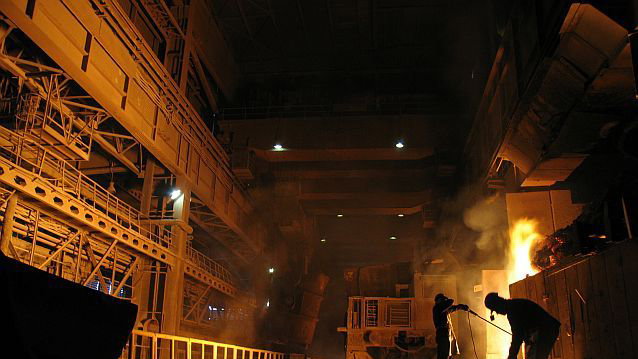
The measures taken to stimulate growth on global markets have reached their limits, analysts say. Mechel’s problems in Romania and ArcelorMittal’s decision to close a furnace in France are the most visible signs of trouble.
One ton of steel reached $344 in London in October, close the lows of 2009, when the steel price fell to some $300/ton, from the over $1,000/ton in 2008. The decline of the steel price in the summer of 2008 foretold the 2009 crisis before the stock markets did.
“As long as there are no signs of a rebound in the demand for steel we cannot see a rebound of the economy. I think steel is a better barometer for the real sustainable economic performance while stock markets are a better barometer for the performance of the financial markets,” says Andrei Radulescu, analyst with brokerage firm Broker Cluj.
“This is because steel is used in capital intensive industries, such as machinery and home construction, shipbuilding and aerospace and when investments in these industries pick up, so does the demand for steel. We are now witnessing a deterioration process because the stimulus packages applied in the past have stopped producing results and the new measures are not as effective.”
The problems on the market can be seen in Romania, as well. Russia’s Mechel, the second largest company in its line of business in this country announced last week that it intended to sell all the four plants in this country there after three of them posted 45% decline in revenue in the first half and losses rose by 76% to almost EUR40 million. The group’s first half losses amounted to over $600 million.
ArcelorMittal Galati, Romania’s largest steel plant is not doing any better either. It currently has only one furnace running of the four in operation before the crisis and started a new voluntary layoff program in 2012 targeting 1,300 employees, with only 700 putting their names on the list. The group run by Indian billionaire Lakshmi Mittal announced the closing of some production facilities in France.
Even China, the driving force behind demand in recent years, has started closing production facilities.
The Romanian steel industry is going through a crisis similar to 2009 when its plants laid off thousands and slashed production as a result of the difficult economy.
The steel production and price trend might signal a new recession in Europe and if that happens, it will definitely affect Romania, too.
Although the market seemed to have stabilized after the 2009 slump, the steel price has gone down 45% since June last year and the steel production in Europe in August dropped to the lowest level since December 2009, according to World Steel Association.
Romania’s steel market is connected to the European and international market via exports, as 60% to 70% of the steel products it makes go abroad and are subject to the global demand trends.
ArcelorMittal Galati used to rely on exports to Turkey, one of the most dynamic economies in its region in the past, but the market is not doing as well as before because of the decline in demand. Moreover, the chief executive of the plant has recently said Turkey has turned from an importer of steel products into an exporter.
Its competitor, Mechel, was also affected by the market decline and now wants to sell its four plants in Romania for some $150 million, after having paid for one of them, Ductil Steel Buzau, about $198 million in 2008.
(English version by Loredana Fratila-Cristescu)