
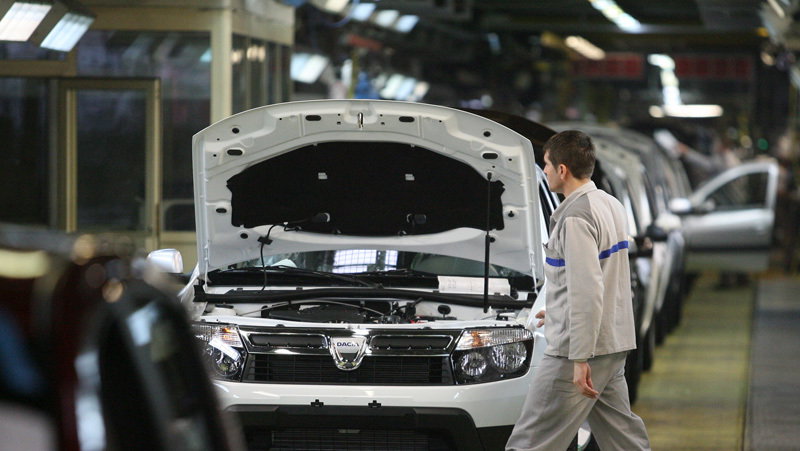
The country’s car production rose almost 22% year-on-year in 2013, to some 411,000 cars, beating countries like Austria (20) and China (15%), according to the production statistics of the International Organization of Motor Vehicle Manufacturers (OICA – Organisation Internationale des Constructeurs d’Automobiles).
“Dacia’s product strategy has turned Romania into a lethal weapon when it comes to growth. We have to be realistic on long-term though. Now the focus is on Ford and its production in Craiova,” said Constantin Stroe, president of the association of automotive manufacturers in Romania ACAROM.
“Dacia has no more room for growth because it’s already reached peak capacity. If Ford’s production, however, goes up close to the plant capacity, we can gain one more place. On the other hand, the automotive industry is not sitting still and we see new changes about production in Italy.”
According to OICA statistics, the last time Romania made it into the top three ranking by growth rates was 2005, the first full year of Logan production at Mioveni. That year, production surged by 59% compared with 2004, the second highest growth rate after Finland’s 105%.
“We can talk about a base effect, a growth that is high because it starts from a smaller base; the important thing to note here, though, is the positive impact of some products in a highly competitive global market like the automotive market is,” said Bogdan Belciu, partner advisory services with PwC Romania.
The year 2013 was a record year for Dacia, with more than 342,000 cars assembled, as well as the first full production year of Ford’s Craiova plant. With its 68,339 cars, an increase of 123% on the previous year, the plant reached its all time high.
On the other hand, its annual production capacity is 300,000 units, exactly as many as the US carmaker committed to assemble after 2012 in the privatization contract signed in 2007. At an average price of EUR12,000, the cars assembled are worth almost EUR5 billion.
“Romania has the potential to continue to grow in this industry because we are attractive for our geographic location and costs. We cannot compare average wages in Romania to those in the West but this is one of the things that attract foreign investment in Romania, despite shortcomings like the poorer infrastructure compared with other countries. Therefore raises can only follow productivity gains and cuts of other costs such as transportation costs affected by the poor infrastructure,” Bogdan Belciu said.
While ranking first by growth rate in the world, Romania ranks ninth in Europe by production volume with its 411,000 cars, ahead of Italy, which assembled less than 390,000 cars in 2013, and behind Belgium with its almost 450,000 cars.
“Whether it’s good for Romania or bad for the others, we can say the local market has easily overcome the crisis in the last five years because of the Dacia range refresh. Other carmakers had a more difficult time, like the PSA Peugeot-Citroen group did,” Constantin Stroe said.
(English version by Loredana Fratila-Cristescu)