
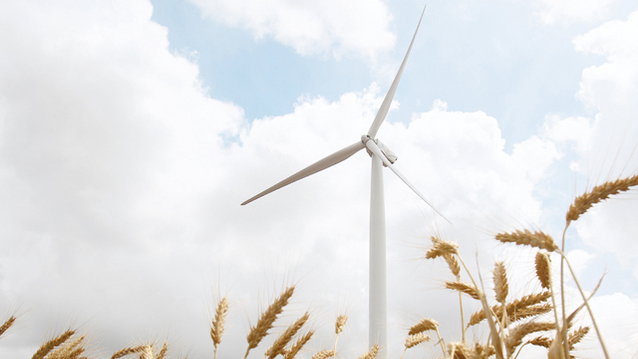

The only countries ahead of Romania were Germany, the UK, Italy and Spain, the European leaders of the wind energy sector.
Last year Romania also became the country with the largest on-shore wind farm, after Czech-held CEZ made a EUR1.1 billion investment in two small towns in SE Romania.
“Among the emerging markets of Central and Eastern Europe, Romania and Poland both had record years – both installing around 8% of the EU’s total annual capacity. Both markets are now consistently in the top ten in the EU for annual installations,” reads the 2012 report published by the European Wind Energy Association (EWEA).
So in 2012 Romania doubled its installed capacity in wind farms for the second year in a row. This brings it to a total of over 1,900 MW, almost as much as the capacity of three nuclear reactors of Romania’s nuclear plant in Cernavoda (SE Romania).
If one considers an average capacity of around 2.5 MW per turbine, this would mean that almost 370 wind turbines were installed last year, i.e. one wind mill per day. And if one considers an average monthly consumption of 200 kWh it would mean that the turbines installed last year could fuel over one million households per year.
The European leader in terms of new installations, as well as of overall wind power, has remained Germany. In 2012 it added 2,440 MW to its grid, 80 MW of which are generated by off-shore turbines.
Renewable energy has seen a fast development in the European Union in the past few years thanks to government support, either through green certificates and mandatory quotas, or through feed-in tariffs.
In Romania the green energy boom has largely been due to the support scheme, one of the most generous in Europe.
In the last three years, the renewable sector, largely wind power, has attracted over EUR3 billion. This year, wind power investments could amount to EUR1 billion, according to ZF calculations based on the average cost of installing one MW – EUR1.5 million, as well as based on forecasts made by Romania’s power grid company Transelectrica as to the capacity set to be installed.
Transelectrica data also shows that last year wind energy investors were rewarded with around EUR250 million – the value of green certificates corresponding to the energy produced. In 2012 wind energy reached 4.64% of the energy production, from 2% in 2011.
Recently several European countries have started to consider freezing or cutting subsidies for renewable energy in order to limit the rise in the price paid by households and the industry for electricity. If limits were set to the state support for green energy, this would result in less investments in the future.
The Romanian authorities are also considering such measures, with solar energy likely to be the most affected, but for the time being the authorities have not reached a final conclusion.
“The turbines installed during 2012 were generally permitted, financed and ordered prior to the crisis feeding through to a destabilisation of legislative frameworks for wind energy,” reads the report of the European wind energy association.
“The stress being felt in many markets across Europe throughout the wind industry’s value chain should become apparent in a reduced level of installations in 2013, possibly continuing well into 2014.”
(English version by Daniela Stoican)