
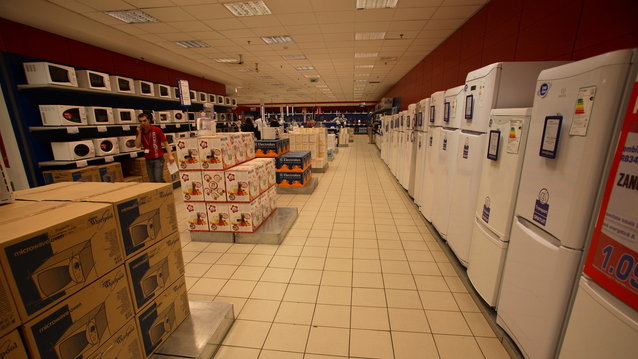

The 20 largest producers of electrical home appliances in Romania posted revenue of a mere 2.1 billion lei (EUR470 million) in 2012 (the last year for which there are public figures) and the top three producers contribute by almost 90% to the total, according to ZF calculations based on Trade Registry data.
The ZF ranking is based on data from the Trade Registry, which takes into account the companies that reported financial figures for 2012. Thus, Electrolux company of Satu Mare, with revenue of around RON450 million in 2012, is not included in the ranking as it did not post its figures on the Finance Ministry’s website. Electrolux would come second in the ranking.
The ranking would also include Miele Tehnica of Brasov, with RON110 million in revenue in 2012, but the company has a different code, namely the production of electronic modules. Overall, including Electrolux and Miele, the market goes beyond RON2.6 billion (EUR600 million).
In this context, the ranking of the largest producers of electrical home appliances in Romania includes 12 players with revenue of below RON4.5 million (EUR1 million), a sign the market is highly fragmented and large foreign groups rule.
Arctic, held by Turkey’s Arcelik, leads the ranking by far, with revenue of RON1.37 billion in 2012 , due to rise on the EUR24 million investment the company operated to boost production capacities to 2.5 million refrigerators per annum. In the wake of production expansion, the company became Europe’s biggest refrigerator producer. Most of production (around 85%) is exported to 40 markets worldwide.
“Romania is becoming a point of interest for producers of electrical home appliances. The Romanian market has a series of pluses, namely it is a EU member and hence has access to this market, has well-trained workforce and low salaries. The geographical position is also a plus as products can easily reach Turkey and Middle East markets,” says economic analyst Aurelian Dochia.
He also specifies Romania has a tradition in this field, so that companies deciding to invest in electrical home appliances production in Romania do not need to start from scratch.
While Arctic brand was retained and Samus was replaced by Electrolux, other Romanian established brands had a different fate. Albalux washing machines produced in Cugir and Fram refrigerators disappeared from the market.
While several Romanian brands vanished, international producers such as Philips came to Romania to produce under foreign brands.
“Production of electronic home appliances could follow the path of car production. Romania has turned into a hub owing to Renault, which attracted other producers,” explains analyst Aurelian Dochia.
Frans van Houten, the chief executive officer of Dutch giant Philips, came to Romania for the first time several weeks ago, to meet several representatives of the political class and private companies as, he said, the Romanian market has growth potential.
One of the reasons Western giants shift towards the East for production is that salaries are 4-5 times lower than in the West.
“There is interest from large producers to relocate their Asian plants, but I believe they will choose to move them from China to the US, where there’s friendly legislation and solid infrastructure. Europe is a too small market for large producers, while the US can absorb production from internal consumption,” says Dan Ostahie, owner of Altex, leader of the domestic electro-IT retail market.
“However, should they choose to move production on the old continent, I believe Romania stands the chance of attracting new investment,” says Ostahie.
Germany’s Karcher group is mulling expanding its production of Romania. The company already has a production partnership with Electroarges.
The options the German company is considering include boosting Electroarges capacity, but also building a plant on a 5-ha land plot the group owns in Curtea de Arges.
(English version by Catalina Apostoiu)