
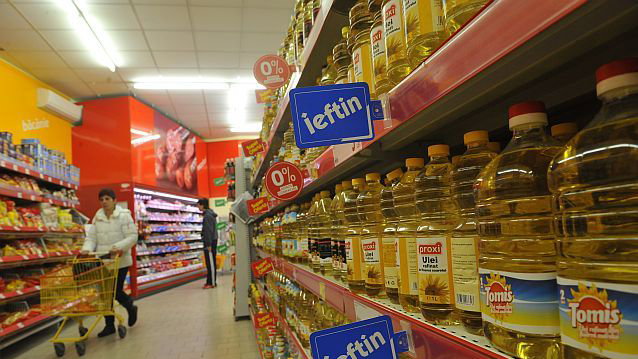
Sales of private label products are estimated by Ziarul Financiar at EUR1.4-EUR1.7 billion in 2012. Private labels have gained massive ground given that a few years ago they neared EUR100 million.
So, while four or five years ago private label milk and yogurt were big sellers only on external markets, now Real, Kaufland and Cora private label products climbed to the top two positions of the sales ranking. The situation is similar on other major segments, such as detergent, soap and toothpaste, where no-name products strongly compete against major brands, as price is the deciding factor.
“Private labels have gained ground because they took advantage of a ‘moment’ that has been going on for several years – where a big part of the buying decision is based on price,” explained Raul Ciurtin, the shareholder of Albalact, the largest Romanian business in the milk industry. The businessman said Albalact itself makes private label products for several retail chains, but did not give names.
“I believe private labels have considerably affected the businesses of small producers, for whose products there is no more room on store shelves, so they end up producing only private label products.”
After winning less visible market categories where the brand’s importance is small, such as napkins or spices, private labels are now going for the main segments of the fast moving consumer goods market, such as milk and yogurt, where a handful of brands used to be top sellers for years.
So, in the ranking of the best-selling milk brands on the Romanian market by volume, retailers’ private labels (such as Pilos and 365) are no. 1, ahead of known brands such as Zuzu, Napolact, Milli and LaDorna, according to data from research company Nielsen corresponding to December 2012 – January 2013. But it needs to be clarified that the private labels are analyzed together, as a generic category, so a brand such as Zuzu or Milli does not compete against one single private label, such as Pilos and 365, but against a whole category. Moreover, while the established brands compete against one another and use major advertising budgets in this battle, private labels are not competitors, as they are present only in the chain that owns them.
Case study: P&G versus private labels
Procter & Gamble has over 20 brands in its portfolio, each with annual revenues of over EUR1 billion worldwide. The giant company became known worldwide for its premium products, which during the boom period were present in most households across the world.
But in the past few years, marked by the crisis, by a consumption decline and by great sensitivity to price, Ariel and Tide detergents (both in P&G’s portfolio) have had to fight against no-name private labels that retailers are pushing to the front of the shelf.
On the Romanian market these products, which are up to 20% cheaper than established brands, climbed to no. 4, ahead of Tide, a brand with tradition, according to a Nielsen survey (for the period January 2012 – December 2012). However, according to the value of sales, Tide ranks ahead of private labels.
On the soap market changes are even more radical, with private labels ending up no.1 in the ranking of sales by volume between January and December 2012, ahead of brands such as Dove, Protex and Palmolive.
It took less than 10 years
In less than a decade, these no-name products have made room for themselves. While in 2004-2005 private labels contributed less than 1% of the overall Romanian retail, now these products are approaching 10% of the total market and there are still growth prospects.
“This market has a potential to grow further. The problem with it is that people got burned with certain poor-quality products and some of them are not very willing to come back,” says Sorana Georgia, who has been running Billa Romania supermarket chain since 2011. The chain has 71 stores and turnover of around EUR270 million in 2011, the last year for which there are official data.
In the case of Billa, private label products contribute around 10% of the total turnover. But there are also players where private labels exceed 50%, such as discount chains Lidl and Penny Market. These low-price chains built their business model on private labels, with their own products reaching 80% of all products in Lidl’s case.
So the 12 players in modern retail have come to make EUR1.4-EUR1.7 billion from private label sales, i.e. 17-20% of total sales.
(English version by Daniela Stoican)