
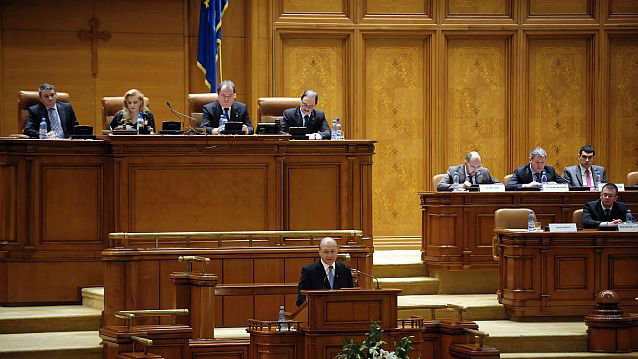
The suspension of the president would be the second situation of this kind since the revolution of 1989, but the situation was different in 2007, when Traian Basescu was suspended during his first term in office. Back then the economy was in full swing and markets did not react visibly because the perception was that the economy was broken away from politics, irrespective of politicians’ decisions. In 2007 Traian Basescu was suspended by Parliament but people voted to keep him in office in a referendum.
Now things are different, the economy is fragile and political decisions can weigh heavily, as was the case on Wednesday, with the leu weakening to a new all-time low of RON4.4715 to the euro on a market where the central bank intervened indirectly to sell euros in order to slow down the leu’s depreciation.
Analysts and businesspeople are concerned about this unexpected turn of events.
Political instability and measures such as the insolvency of state-run company Hidroelectrica have “devastating” effects on the economy and lead to financial blockage for the very category of firms that had difficult access to financing in the first place, says Florin Talpes, CEO and founder of Bitdefender, a developer of IT security solutions.
“The Romanian economy is very sensitive. What is happening now has devastating effects because a big problem we had in Romania was this: bank resources were attracted by the state. The economy did not have much access to financing anymore.”
Erste Bank analysts see the situation in the same bleak colors. In an analysis they described the latest events (even before the announcement of the start of impeachment proceedings) as unprecedented, barely legal actions, whose purpose is to depose the president. But the economists of the Austrian bank have for the time being kept their forecasts on the exchange rate and on the state’s financing costs.
Political developments in Romania could negatively affect economic growth, as well as the program with the IMF and the European Commission, but the risk of fiscal policy slippage is significant, reads in turn a report of JP Morgan, the largest US bank.
(English version by Daniela Stoican)