
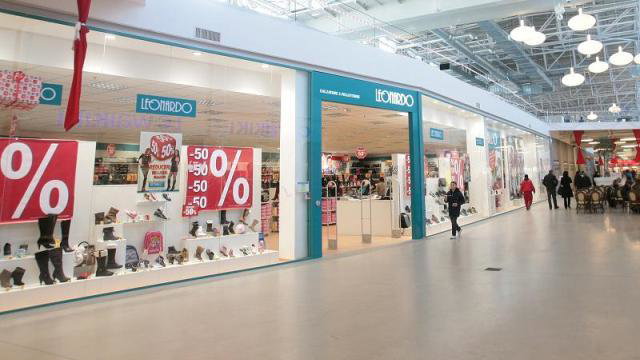

CCC, a low-cost footwear brand just like Leonardo, entered Romania in the autumn of 2012 with a store in Feeria commercial gallery of Baneasa complex, and has already reached 21 units, planning to get to 35 stores by yearend.
The Polish company has expanded aggressively to catch up with its direct rivals Leonardo (launched in 1994) and Deichmann (2007).
“We replaced Leonardo in AFI Cotroceni and we will open a store in AFI Ploiesti that will also replace a Leonardo unit. With the store of Ploiesti we will reach 22 units and by yearend we want 35 stores in Romania,” said Sachin Arora, manager of Peeraj Brand International.
In AFI Palace Cotroceni, CCC set its store on one of the “main shopping arteries “ on the ground floor, having as “neighbors” big names such as Zara, Marks&Spencer or New Yorker.
A pair of shoes costs RON100-120, according to ZF data, and most of the pairs are leather ones.
Moreover, the labels of CCC products most of the times read “made in Poland”, as the company holds both own plants and subcontractors on its local market. The group that owns CCC chain was founded by entrepreneur Dariusz Milek, the king of low-cost footwear in Poland.
“People are ever more careful about the way they spend their money. Paradoxically, this is helping us,” stated Milek at the crisis onset.
Romanian entrepreneur Florin Panea, who controls Leonardo, tried his hand at a similar business model. However, in the second half of 2009 Leonardo went insolvent with debts of EUR100 million and stores opened abroad were among the first to be shut down. In recent years, the company has also closed down several stores of Romania in the wake of the restructuring process.
About the AFI store, Leonardo representatives say it will be relocated, with the company being in advanced talks with the owners of another space in Bucharest. “Given the medium/medium-low mass segment we address and on which we want to focus further, we’re interested in retail spaces where the ratio between rent charges and revenue should be favorable and range within our budgeted parameters,” say the retailer’s representatives.
They add the retailer has carried out cost optimization processes on all the segments and it will now cut costs related to rents it considers as exaggerated.
While Leonardo and CCC count on the same business model, namely low-cost footwear, the former bet only on retail, while the latter also opted for own production. “The shoes sold under our own brand Lasocki are made in Poland, exclusively from leather and account for 30% in total store products,” explains Sachin Arora. The company includes another eight brands in its portfolio, such as Piazza Italia, Women Secret or Kazar Shoes. Another 60 brands manufactured in Poland by or for CCC are added to Lasocki shoes.
The company in 2012 posted revenue of over EUR300 million.
Around 20% of all products sold by CCC are manufactured in the company’s own plants, while the rest are made by subcontractors following the models of the group. Around 3,000 models are manufactured annually. The group set up a business model similar with that of giants Inditex or H&M.
At the opposite end, in Romania the only retailers that also carry out production activities are Musette and Denis of Suceava, both companies addressing above-average income persons.
However, Romania ranks 14th among the world’s biggest footwear exporters, with a value of almost $1.2 billion in 2012. “Made in Romania” shoes go West. Still, Romanian plants export under the brands of foreign companies.
The shoes manufactured in Romania are among the world’s most expensive, with an average price of $23.4 (RON76.2), the fourth highest in the world, after Italy, Portugal and France, according to Worldfootwear data.
(English version by Catalina Apostoiu)