


An average of 105 plans landed on the largest airport of the country, Henri Coanda, each day last year, while 103 trains entered the Bucharest North Station.
Henri Coanda also beat the railway station in terms of traffic, as almost 5.1 million passengers transited it last year, while only 3.6 million people arrived or departed from Bucharest North, according to the data provided by the officials of the airport and of CFR Calatori. Things were completely different twelve years ago.
In 1999, the trains to and from the Bucharest North Station carried 6.3 million people compared with only 1.6 million travelling from the Otopeni airport. That year the airport had only 38 planes taking off and landing on it. There are no official data about the number of trains arriving or departing from Bucharest North, but estimates point to 120.
Romanians travel abroad for work, business or for holidays. Almost 88% of the passenger traffic on the Otopeni airport is generated by trips abroad, its officials say.
Demand for plane tickets is also higher from Romanians working abroad. At least 2.1 million Romanians are working in the European Union member countries, mostly in Italy, Spain and Germany, and this is the first official figure reported by the representatives of the European Commission last April.
“The lifting of the visas and the deregulation of the labor market helped many Romanians go abroad. Whereas only two planes per week were taking off from Otopeni in the nineties, now an airline has four or five daily flights,” says Valentin Iordache, the spokesman of Compania Nationala de Aeroporturi Bucuresti (Bucharest National Airport Company) created by the merger of the city’s two airports Henri Coanda and Baneasa-Aurel Vlaicu two years ago. The company posted EUR94.3 million in revenue and net profit of EUR10 million in 2010.
A number of 38 airlines are currently operating off the Otopeni Airport, providing regular flights to 11 domestic destinations and 51 destinations abroad, in addition to 7 charter flights. The number of routes operated off the Otopeni airport has developed over the last ten years so that the number of landings and takeoffs reached almost 77,000 last year compared with 27,776 in 1996.
Plane ticket prices are more attractive given the significant competition on certain foreign routes generated by the high number of airlines operating on the Otopeni airport.
Several airlines announced they would introduce new flights to destinations abroad in 2012, which will drive up the number of landings and takeoffs.
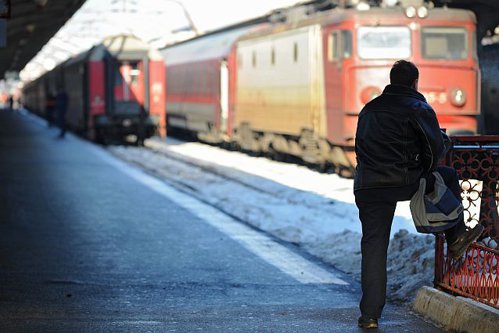
In comparison, this year’s train schedule shows 103 trains leaving from Bucharest North every weekday, as well as 85 trains leaving on Saturdays and 93 on Sundays. On the other hand, 101 trains will arrive every weekday in 2012, and 91 on Saturdays and 84 on Sundays.
Valentin Iordache says more than EUR200 million have been invested in the Henri Coanda Airport in the last fifteen years, which attracted many airlines.
On the other hand, investments made in railways are insignificant and that led to the deterioration thereof, making train trips longer. However, European Union encourages railway transport, but there are only two European corridors passing through Romania that are worth upgrading so as to make speeds of 160 kilometers/hour possible: Corridor IV and Corridor IX, according to the officials of the country’s Railway Industry Association.
A Bucharest-Iasi (NE Romania) trip by InterCity train lasts six and a half hours and costs 103 lei (EUR24), according to infofer.ro data. A cheaper train takes longer to reach the city, about seven hours.
A plane trip costs RON275 (calculated for a ticket booked from national airline carrier airline Tarom on Wednesday for February 3) and takes only one hour.
(English version by Loredana Fratila-Cristescu)