

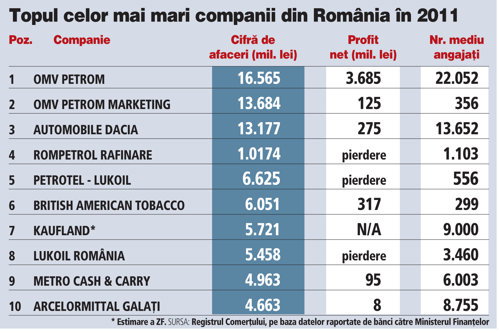
Except for banks, the more than 270 companies considered the top players in the Romanian economy posted cumulated revenue of RON356 billion in 2011, that is more than 60% of the country’s gross domestic product. Top 300 banks and companies together employ more than 600,000 people, one quarter of the total number of employees in the economy.
“Although the reports filed by these companies can be explained in various ways, the National Statistics Institute itself showed today (Tuesday i.e.) that consumer spending went up based on fuel sales. This explains why Petrom made a profit that the civilized world would find hard to imagine, while banks saw their profits down because they had to book provisions for the non-performing loans,” says Cristian Parvan, secretary general of the Romanian Businesspeople Association (AOAR).
Two out three companies or banks in the top 300 made no profit in 2011 or even posted losses.
Some of the steepest declines in revenue last year were those of Nokia, which closed its production facilities in Jucu (in Cluj County, NW Romania). It saw its revenue down 40% to EUR968 million. Compania Nationala A Huilei (the bituminous coal mining company) posted 30% lower revenue in 2011, at EUR109 million.
Top profit growth rates among local companies registered Europharm, the drug plant of UK’s GlaxoSmithKline, whose net profit soared from EUR276,000 in 2010 to EUR6 million in 2011, as a result of the increase in drug exports. Romsilva (the public corporation in charge of the country’s forests), posted EUR4.9 million profit in 2011, much higher than in 2010, when it made merely EUR243,000.
At the other end of the profit evolution was Rewe Group, the operator of the discount stores Penny Market and Penny Market XXL, which saw its income shrink by 83% to EUR1.2 million. The company is going through an expansion process, after opening 12 stores last year and 3 so far this year.
 However, the data centralized by ZF shows that the cumulated net profit of the top 300 companies on the market stood at EUR4.5 billion, 28% higher than in 2010.
“It was only natural that their profit would increase because of the switch from monopoly of state-run companies to monopoly of private companies and therefore very high increases in the water price occurred, for instance. Furthermore, we won’t ever know, for instance, what price Mittal Steel pays for its coke and what price it sells its sheet metal for,” Parvan explained.
The ranking of the largest companies in Romania continues to be dominated by foreign investors. Only four companies held by Romanian entrepreneurs, Interagro (Ioan Nicolae), RCS&RDS (Zoltan Teszari), Dedeman (Dragos and Adrian Paval) and Arabesque made into the top 50 by revenue in 2011.
“Foreign investors dominate the economy. The data from the National Statistics Institute show that there are 15,000 foreign groups (of at least three companies) and only 5,000 Romanian companies,” Parvan said.
Among the most dynamic companies in terms of revenue trend in 2011 were Master Chem Oil, which posted EUR885,000 in 2010 and then increased it by a factor of 140 in one year to EUR125.7 million. The Romanian branch of General Electric International saw its revenue rise from EUR37.8 million in 2010 to almost EUR164 million last year.
The highest number of people were hired by Delphi (car parts maker), supermarket chain Mega Image and telecom operator RCS&RDS. They were the only ones to hire more than 1,000 people each in 2011.
Romanian state-owned postal company Posta Romania remained the biggest employer in the economy in 2011, with more than 32,000 staff, after having cut 2,600 jobs. It will continue firing people this year, as well, otherwise it risks going insolvent. It posted EUR15 million in losses last year.
The turnover reported by banks to the Trade Registry includes their treasury operations, as well. Yet the way banks actually calculate it differs and yields a much lower net figure, based on interests and fee-related spending and revenue. For instance, Trade Registry data show BRD to have posted RON21.5 billion turnover in 2011, while its officials say it actually made RON3.22 billion, with an average number of employees of 8,491 (instead of 8,011 as the Trade Registry data shows).
The data provided by the Trade Registry did not include any information about the 2011 results of Romtelecom, Kaufland, Selgros and Domo. Judging from ZF’s data, however, these companies are among the top 300 largest players in the economy.
(English version by Loredana Fratila-Cristescu)