
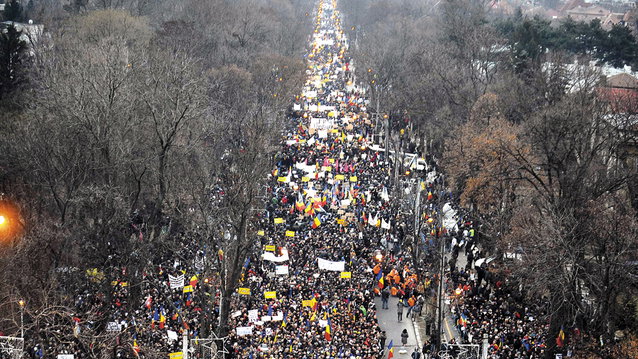

In Bucharest several thousand people took to the streets on Thursday –7,000, according to Gendarmerie estimates, or 13,000, according to participant information.
People demanded early elections, the fall of the Government and the resignation of the president.
The question is how feasible it is to stage early elections, considering that there are around eight months to go until scheduled elections. And would the opposition manage to impose its program and make it credible in the eyes of the people?
On the other hand, president Traian Basescu on Thursday made a public appearance for the first time since the start of protests. He met ambassadors to Bucharest, but did not say a word about the protests, although in the past he did not miss any opportunity to respond.
Instead, he now talked about the economic growth recorded in 2011, which, he said, was above many expectations.
Preliminary official data to be published in February will probably show that the economy grew by 2% or slightly more in 2011, driven up by a good agricultural year and by an unexpected rise of the construction sector. Inflation in turn was at its lowest in 20 years.
But things are not settled yet. Fear over what will happen in 2012 is even bigger than in 2011 because of the external context. And a worsening of the situation could hurt Romania’s economic growth, which is expected to be around 2%.
At the same time, data for 2011 show that foreign investment collapsed by over 40%, while public debt continues to rise fast, which could raise question marks over the cost of future financing. And Romania needs to borrow around EUR16 billion this year to cover its budget deficit and roll over debt.
But there are also signs of things starting to budge in the economy. Companies are hiring and the managers of companies queried by ZF said they were awaiting turnover growth in 2012.
The political factor is in turn important to encourage growth and an economic program is essential for the development of the economy.
In the economic program launched last spring by opposition alliance USL (Social-Liberal Union) proposes the halving of state spending on goods and services, which amount to around EUR8 billion per year. This is the main measure meant to counter the decline in public revenue, following a cut of the social security contributions and the reduction of personal income taxes, which are included in the same program.
Opposition parties PSD (Social Democratic Party), PNL (National Liberal Party) and PC (Conservative Party) propose the return to the progressive tax system, but “downwards,” i.e. the income tax for high salaries would not exceed the current 16% flat rate.
The value added tax is set to decline gradually until the end of the four-year term from 24% to 19%.
According to the document, the target of the measures proposed for the labor market is the creation of 1 million new jobs.
However, all these proposals need to be debated publicly. At Thursday’s demonstration, USL leaders did not say anything about this program. Their major demand is for early elections to be organized and a prospective resignation of president Traian Basescu.
At the meeting, PSD leader Victor Ponta said “this is the end of Traian Basescu and a new start for Romania.”
But Romania also needs dialogue.
In fact, what could USL demand from those in power, given that it is hard to believe, at least at this time, that early elections will be held?
Firstly, to give up the merging of local and general elections, which was decided at the end of last year, a normative act challenged by the opposition and by civil organizations. Then to go back on challenged laws – the pension law, the new wage law, and the Labor Code, as well as freeze all projects that president Traian Basescu calls “reforms,” which, he says, will continue into 2012. Dialogue should start and the parties currently in power, whose legitimacy is now being challenged, should stop this process until a no longer challenged majority is formed.
Englsh version by Daniela Stoican)