
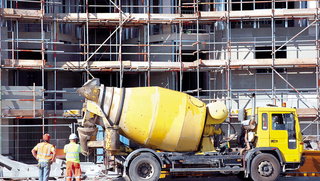
All in all, the twenty largest construction companies are employing about 29,000 people and most of them increased the number of employees, according to the data of the Labor Inspection Department made available to Business Construct magazine.
The major construction companies that hired most people this year are Hidroconstructia, Astaldi Spa and Delta ACM, which had about 600 employees more than the 2011 employee average, according to the Labor Inspection Department and Finance Ministry data.
Astaldi Spa operated the highest increase in the number of employees, 152%, followed by Strabag, 71%, PA&CO international, 52%, all of which expect significant revenue growth this year.
After hard times during which about EUR5 billion vanished from the construction market and 100,000 people left, most large local builders resumed hiring this year. Statistics show the number of employees increased at 16 of the 20 largest companies in this business this year.
“I cannot say I can easily explain this rise in the number of employees, because there have been many projects closed this year, work on many highways stopped, all of which were important projects, and that normally leads to fewer jobs. However, the large companies that had the necessary capacity, continued work on certain projects, hence the increase in the number of employees, maybe,” says Razvan Aron, first vice-president of trade association of construction companies in Romania (PSC).
Aron says that even though the major employers continued to hire this year, 2013 looks ‘gloomy’ especially for the small companies, which will be faced with a dearth of orders as of next spring.
“Even though many of builders are small, I see them having a very difficult time as of next spring. I don’t think we will see any more hiring, but on the contrary; I don’t see any new investments in this field. Large companies, too, will eventually feel this dearth, because most of them depend on the small ones especially for subcontracting,” Aron explained.
Whereas Hidroconstructia, Astaldi and Delta ACM created the most jobs in the past year, the companies that had to lay off people were Tel Drum (124), Aedificia Carpati (70), Intretinere Mecanizata a Caii Ferate (49) and Iasicon (5).
Only one of the top 20 employers, Intretinere Mecanizata a Caii Ferate, is state-owned and the rest are private companies. Experts say private companies dominate the construction market.
“About 99.5%-99.7% of the construction market is privately-held, which is good for the labor market, since this system is known for the efficiency and profitability in terms of company management,” says Tiberiu Andrioaiei, first vice-president of PSC. He added that even though many projects were halted towards the end of this year, work continued on the market of large builders, especially on the market of building insulation projects.
“The construction market did not increase, there weren’t more projects to require more workers; I think we can talk about an increase in the number of employees because of the major on-going projects,” Andrioaiei explains.
More than half of the 20 largest builders are companies that take mainly infrastructure projects, while 35% of them operate on the civil engineering market. Part of the reason why the labor market in the construction industry is dominated by companies taking infrastructure projects is the high number of investments in the sector. However, infrastructure investments are uncertain at this time of the year, because the Transport Ministry’s budget was cut by some EUR300 million after the budget revision and the EU funds for the “Transport” program have been suspended. Some construction companies went looking for work abroad to keep their revenue from shrinking.
“The increase in the number of employees was because of the expansion of the construction site we have in Iraq, which required more workforce. We hired more people for a total of 150 at the site, but we lately haven’t had any need for more,” says Florea Diaconu, the businessman who owns Bucharest-based Delta ACM.
Delta ACM had almost 1,800 employees by the end of August, compared with an average of 1,214 in 2011, according to the data seen by Business Construct.
On the other hand, Mirela Marinescu, recruitment manager with APT group, which operates in the human resources business, believes the rise in the number of employees of the top 20 employers locally can be the effect of the government contracts some companies won the past, which started being funded this year. This is especially true for infrastructure projects.
Recruitment has turned into a really difficult thing to do for some builders; the say the number of people who really know their trade is shrinking, despite their CVs showing secondary or even higher education.
“Unfortunately, the applicants coming in for interviews are not qualified when it comes to knowledge. Fewer and fewer of them have a level of training close to what we require. I can’t say people are better or worse trained than they were two or three years ago, maybe only those who graduated before the fall of communism really knew their trade, but they are starting to retire now,” Florea Diaconu says.
To compensate for the shortage of skills, he sends his employees to training classes in specialized schools, because he says today’s young people, either high school or college graduates have no idea what they are supposed to do on a construction site.
(English version by Loredana Fratila-Cristescu)