
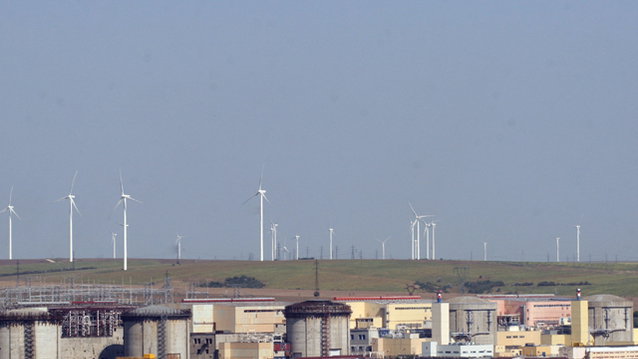

At the moment one in five light bulbs in Romania are powered by the two reactors of the Cernavoda plant, with the plant ensuring 20% of Romania’s energy consumption.
“Two more reactors would double our production, (…) provide energy at low prices for the population, ensure security and energy independence.” He says these are more than enough reasons to continue to develop the nuclear sector in Romania.
The Romanian energy system is indeed very old, with 80% of thermal power stations being past their lifespan, and a third of hydro-power stations needing replacement. On the other hand the two additional reactors in Cernavoda would come at a time when the Dobrogea (SE Romania) is saturated with wind power projects.
Dina is optimistic and says a project such as this one should go ahead, giving two arguments in favor: the increase in energy consumption and the drying up of natural resources.
However, Romania is now struggling to return to the pre-crisis energy consumption, with a 1.3% decline being recorded in the first three months of the year. The thesis of the drying up of resources is valid for oil and gas. But coal, which 40% of local energy production is currently reliant on, would be enough for hundreds of years from now.
“But we live in a reality that imposes a direction: a steady increase in consumption and a dwindling of conventional resources. With this in mind, I have always advocated that nuclear energy is part of the solution,” Dina said.
So the head of Nuclearelectrica is still optimistic over the future of the two new reactors at Cernavoda and believes more investors could show an interest by September 15, the final deadline for submitting the offers.
The project to build reactors 3 and 4 at Cernavoda started off very well in 2007, managing to attract the largest European energy groups – CEZ (The Czech Republic), Enel (Italy), GDF SUEZ (French-Belgian group), RWE (Germany), Iberdrola (Spain) and Romania’s ArcelorMittal. But the Romanian state’s many hiccups, which came on top of the international crisis, made four of the investors abandon Romania’s main energy project. Only Enel and ArcelorMittal stayed on, and subsequently two Asian companies, Korea Nuclear and China Nuclear Power Engineering, also expressed interest in the project.
Dina said updated information on the value of the investment will be available by September, this being one of the reasons for delaying by six months the deadline to submit the binding offers, from April 15 to September 15 2012.
Recently the Economy Ministry, owner of Nuclearelectrica, announced that a Chinese company, China Huadian Engineering, had won the auction organized by the Romanian state to select an investor that will build a new, around 500-MW facility worth $1 billion in place of two disused facilities in Complexul Energetic Rovinari power station. If they also get involved in the Cernavoda project, Asian companies would become one of the main investors in Romanian energy.
Dinu says about the company he runs that Nuclearelectrica has an investment budget of 344.8 million lei for this year, financed entirely from its own resources. Last year Nuclearlectrica, the second-largest energy producer in Romania, posted a turnover of RON1.58 billion (EUR0.34 million) and a net profit of RON95 million (EUR20.7 million). (EUR1=RON4.5885)
(English version by Daniela Stoican)