
The consortium consists of the companies of E.ON Group (Zapadoslovenska energetika in Slovakia, E.ON Czech Republic, E.ON Hungary, E.ON Romania), MOL Group (the subsidiaries of the six participating countries), Hrvatska elektroprivreda of Croatia, PETROL (in Slovenia and Croatia) as well as Nissan and BMW.
The network will comprise 222 multi-standard (50 kW) and 30 ultra-fast (150-350 kW) charging stations for electric vehicles along the main European transport corridors and the trans-European transport network (TEN-T), and it will connect six countries in CEE on main routes: the Czech Republic, Slovakia, Hungary, Slovenia, Croatia and Romania.
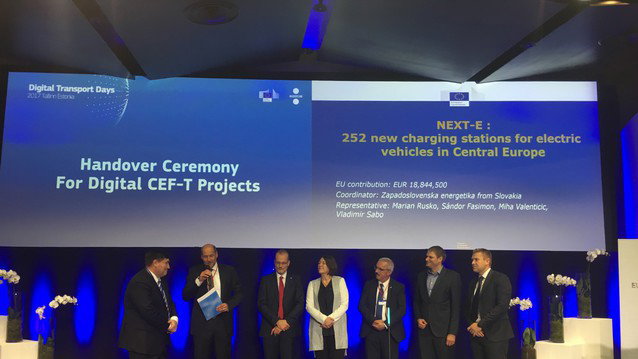
The financing agreement with the Innovation and Networks Executive Agency (INEA) was initialed in Tallinn on Thursday by NEXT-E partners as part of Digital Transport Days, and the move marks a milestone in extending e-mobility to member countries and in the future of transport at European level.
The NEXT-E project was selected by the European Commission in July 2017 for co-financing under the Connecting Europe Facility (CEF).
According to the statement, the NEXT-E consortium will receive EUR 18.84 million to implement the project, making this the largest CEF-funded project for electric vehicles.
The NEXT-E project involves the co-operation of four top performing companies in the electricity, oil and natural gas sectors that have joined forces with car manufacturers to create an interoperable network of electric vehicle charging stations as a viable alternative to motor vehicles equipped with internal combustion engines.
The installation of fast charging stations will begin in 2018, while the installation of ultra-fast stations is planned for 2019, anticipating the new generation of extended range electric vehicles. The overall completion of the project is estimated for the end of 2020.