
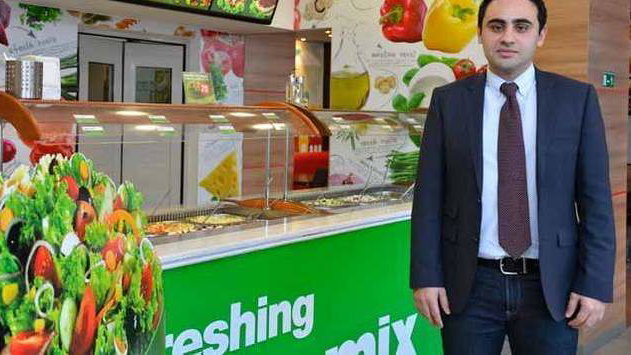
“We have repeated the word ‘crisis’ too many times. If you want to move forward, you have to use the previous year as sole reference point instead of hoping to return to the 2007-2008 level. Otherwise you will always be unhappy. This is the market now.”
At only 24, Maissam Mrad runs the Springtime business, with turnover of around EUR12 million, but has been involved in the family’s business for 8 years.
His uncle Mohammad Murad is known mainly for his businesses in the hotel sector, but the manager of Springtime made a point of saying the correct family name is Mrad, not Murad – the name under which the two Lebanese brothers [his father and uncle] have made a name for themselves in Romania in the past two decades.
He also says on a market affected by the decline in consumption and in the purchasing power, turnover and profit are currently less important. Keeping the number of customers has become the key indicator.
“Currently things should not be looked at in terms of the number of customers, which has remained steady, but in terms of the fiscal receipt.”
The Springtime chain, which has 23 permanent restaurants and a seasonal one, has hundreds of thousands of customers per month, according to Mrad.
“Our turnover stagnated last year, but we put in efforts in order to stick to the 2011 level.” In 2011 Spring Prod Com, which manages the restaurants, had a turnover of 49 million lei (EUR11.6 million), down by around 10% against 2008, the last boom year.
He says making customers loyal is the most important thing for fast food chains, but that when purchasing power is low you have to fight to get new customers. “Making customers loyal costs less than bringing new customers in,” he explains.
The fast food market is one of the most competitive ones, with major international players such as McDonald’s, Subway and KFC being present on the market, but Mrad says this not something new and that competition has been high in the last 15 years.
A twenty-year history
Springtime was set up in Romania in 1992 by the Lebanese family Mrad and has remained a family business.
“The business was started by my father and uncle, both trained doctors. Back then [in ’92] on the local market there were only traditional Romanian restaurants and they wanted to develop another type of restaurants, where you could get food fast,” says Maissam Mrad (24), who has been working for the family business since he was 15 or 16.
Born in Romania and raised in Sweden, the managing director of Springtime says he started from the bottom up at Springtime, selling hot dogs in Bucharest’s Gara de Nord railway.
The managing director of Springtime says that from his parents’ recollections 21 years ago, when the first restaurant in Piata Victoriei square was opened – the line extended even outside the restaurant.
“These long lines lasted for three years. The products were new, the atmosphere was different then.”
At the time there were no other fast food restaurants in Romania, with giant Mc’Donald’s entering the market as late as 1995.
Now most of the Springtime restaurants (75%) are in shopping centers.
Having put the development of the restaurant chain on hold in the past few years, Maissam Mrad says he is considering starting to open restaurants again. He says he is also thinking of developing other concepts, but does not provide details on this.
“We believe the market will recover in the future and that it has potential.” He does not say if he is looking at street locations or at malls, but that his family has a saying:
“In order to see if a space has potential or not, you shield your eyes, look to the ground, and count the pairs of legs that walk by.”
One such location is Piata Victoriei, which he says has become one of the areas most crowded with restaurants in Bucharest.
“We are interested in opening new restaurants if good spaces appear. For each new location we do research, analyze and decide.”
Although so far the manager has mainly focused on Bucharest, the head of Springtime says the provinces also have a potential, and he is mainly looking at cities with over 120,000 inhabitants.
“Five years ago we really believed we would get to the Moon,” he jokes. “Now it’s not as easy to make predictions anymore. We are dependent on the market.”
But future plans include the word “franchise”. “There is interest both in the country and outside it,” he says.
(English version by Daniela Stoican)