
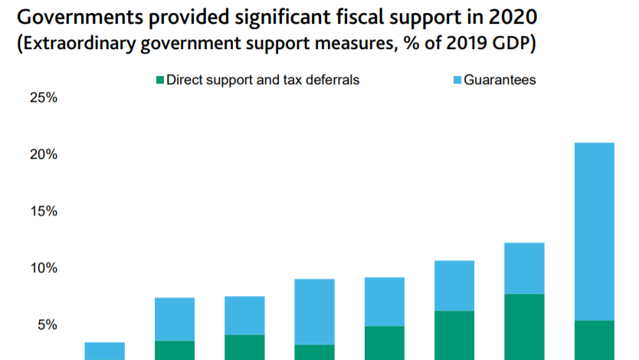
Bulgaria and Croatia provided government support of 7-8% of GDP in 2020, followed by Slovenia and Slovakia with nearly 10%. Support packages granted by the governments of Hungary and Poland stood at 10-12% of GDP, and Czech Republic disbursed the biggest support package in CEE, of over 20%.
Over half the funds represented direct support and tax deferral measures and the rest were government guarantees, the report noted.
“We expect that government support measures will remain in place throughout much of 2021. However, governments will increasingly face a difficult balance between supporting a nascent recovery and beginning to withdraw measures to shore up the public finances and allow structural change in sectors facing more permanent damage from the crisis,” Moody’s noted.
The ratings agency forecasts the CEE economies to grow by a robust 4.1% of GDP in 2021, as the region recovers from a severe 5.1% contraction in 2020, driven by the coronavirus outbreak. The severity of the contraction ranges from less than 4% for Poland, by far the region’s largest economy, and Bulgaria, to 8% or more for the Czech Republic and Croatia.
Although the pandemic will continue to weigh on economic activity, particularly in the first quarter of 2021, Moody’s forecasts that CEE economies will grow robustly for the full year, primarily driven by a pickup in private consumption and strong external demand.