
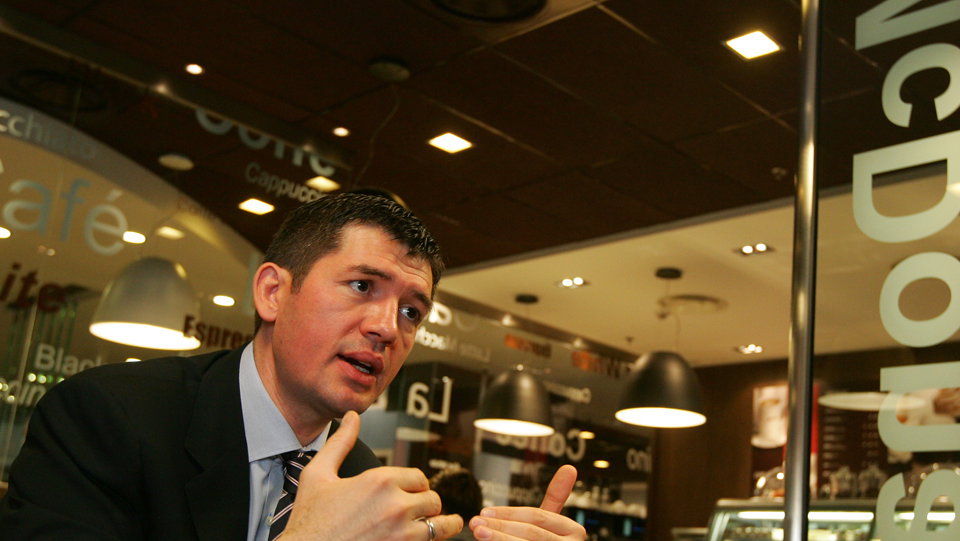
In the long run, McDonald’s Romania network might grow to 100 restaurants, because the number of such restaurants is only 0.3 per 100,000 people, three times fewer than in Hungary and six times fewer than in Switzerland, Netherlands and Sweden.
“We may reach a 100 restaurant network in Romania, there is definitely potential for it if we look at our main indicator, the number of restaurants per 100,000 people,” Daniel Boaje, 43, says.
“There are 67 restaurants for 20 million people in Romania, while Hungary has 98 and half the population. It’s all up to the purchasing power (…)”
McDonald’s has been expanding cautiously in the past few years due to the financial crisis and the more than 15% decline in consumer spending in 2009-2013. The company opened only one restaurant in 2011 and in 2012 and two last year.
“We’ve opened 10 new restaurants in the last five years.”
The fast-food chain has expanded in the large cities of the country and will focus on those cities where it is already present in the future. The smallest city where it opened a restaurant is Deva, whose population numbers more than 50,000 people.
The company budgeted the opening of two new restaurants this year, and will focus on drive-thru restaurants, which are better than those in malls or street front locations. Drive-thru’s are better because of their parking lot, 24/7 opening hours, because they allow customers to place an order without getting our of their cars, have playgrounds for kids and allow for opening of McCafe coffee shops.
The investment in such a store is higher because the company also needs to buy the land on which to build it. Therefore, one such restaurant may cost as much as EUR4 million, company officials said.
Out of its 67 restaurants in Romania, 33 are drive-thru’s, 17 are in-store (street front locations) and 17 operate in shopping centers.
Most of the restaurants are operated by the company itself and only 7 by franchisees. Boaje says the company is not accepting any franchise application now but ‘when Romania’s development trend becomes predictable” it might make this part of the business a strategic development avenue.
“We prefer to buy our own land wherever we can. About one quarter of our restaurants operate on our own land,” Boaje says.
As the space in malls cannot be bought, and the street front spaces cannot either in most cases, the fast-food chain thus chooses to open drive-thru’s.
Although he admits the company is focusing on drive-thru restaurants, Boaje says that he is looking at any space, especially malls, which have become the main shopping destination of Romanian consumers.
“It should be said that malls are a very competitive environment (as the largest chains in the business operate there i.e.) and most often we, in our position as tenants, depend on the mall’s ability to attract customers.”
McDonald’s best restaurants in Romania are those in Bucharest (Gara de Nord – the city’s north railway station, Piata Romana, Unirea Shopping Center, Brancoveanu and Dristor), Timisoara, Craiova, Ploiesti, Brasov and Galati (the latter five operating in street front spaces).
These restaurants generate about one third of McDonald’s business, according to ZF estimates and market data.
McDonald’s entered Romania with the restaurant on the ground floor of the Unirea Shopping Center in 1995 and has invested EUR150 million in the country ever since, Boaje says.
This year’s plans include at least two new restaurants and three to four McCafes.
Daniel Boaje says one of the development priorities of the company in the near future is the McCafe. Customers in other countries such as France can already order via the mobile phone or the web and home delivers are already popular in Asia, he added.
“We’ve been making deliveries in Romania since 2012, to the office area in Piata Victoriei from our restaurant in America House (one of the buildings there i.e.). We want to test office/home delivery with at least one new restaurant and want to test in and outside Bucharest.”
Daniel Boaje will not reveal the sales of the company, merely saying “the business is developing and growing profitably”. McDonald’s sales went down during the crisis from EUR110 million in 2008, the last year of economic boom to EUR89.7 million in 2012, according to the latest official data. Profit dropped to EUR0.9 million in 2012 from EUR9 million in 2008.
McDonald’s remains the leader of the restaurant market in Romania, followed by KFC and Pizza Hut.
Still, Boaje is optimistic for this year, saying that even though one cannot expect a surge in consumer spending, lending or purchasing power, there is no unpredictability.
“Only the lack of clarity leads to higher cautiousness. Nothing that has happened in 2014 surprised us, we knew about the fuel excise duty and about the rise in power prices, there is predictability in the market.”
(English version by Loredana Fratila-Cristescu)