
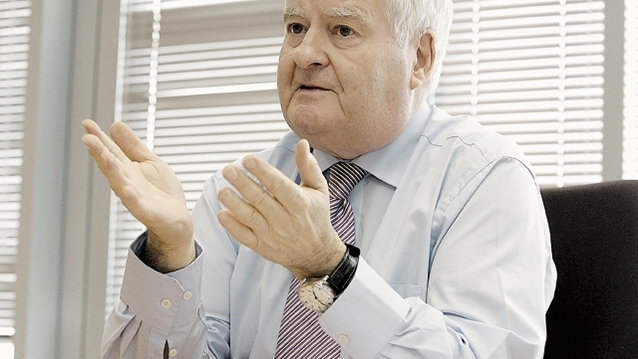
The Swiss manager is the interim CEO of Ameropa Grains until the end of this year, after Cezar Gheorghe’s departure. Ameropa Grains has 200 employees in Romania and is owned by Swiss magnate Andreas Zivy.
At 65, Wirth continues to work in Romania and, despite “having traded” cement for grains and chemical products, he does not hesitate to give advice to managers in the construction sector: “don’t charge prices that don’t cover your costs”, “hold on to cash” and “pay your contractors and subcontractors,” writes Business Construct magazine.
Markus Wirth was CEO and president of Holcim Romania from 2004 to 2011, a time during which the company reported sales of over EUR1.5 billion and net profits of over EUR200 million. He was replaced at the helm of the cement producer by Daniel Bach.
Having gone into retirement from Holcim in 2011, he remained chairman of the board of directors of Holcim Romania based on a mandate that ended in May this year.
Wirth then moved on to another Swiss group – Ameropa – joining the board of directors of Ameropa-held fertilizer producer Azomures, where he is also involved in running an extensive investment program, which is set to be finalized at the end of 2015.
The end of Wirth’s term as chairman of the Board of Directors of Holcim Romania coincided with his exit from the board of the Foreign Investors’ Council, with Wirth returning to the helm of the Chamber of Commerce Switzerland-Romania as president.
Wirth’s career spanned more than two decades at Holcim, including the 7 years he spent as CEO of Holcim.
“I don’t intend to actively seek new positions after completing my mandate as interim CEO of Ameropa Grains, but I am always willing to help, if I can,” admits Wirth, who set up a consultancy in Switzerland.
“We cannot talk about rises”
Having recently exited the construction sector, Wirth is still connected to this market and says, citing statistical data, that the first half of this year is below the first six months of 2012. Because of the slowdown of construction work, the sector is not in good shape.
“I don’t remember figures from back in 2004, but in 2006, 2007, 2008 the cement market grew by 16 to 22% It is clear that such declines are not sustainable, but one only realizes this in the end. Then the market declined. Last year we recorded a slight rise, of 2%, which could have been a sustainable one, but in 2013 the market is on the decline again.”
He says as opposed to 8-10 years ago, there is no growth to talk about now, and that one can only make sure the decline is not too big.
In 2007-2008 the most difficult situation he faced was that local production was insufficient, and the company had to import clinker from other plants within the group in order to cover demand in Romania. But things changed after the crisis came and the company decided to abandon plans to build a new cement plant.
“As things stand now, Romania will not need a new cement plant in the coming years,” Wirth says.
He says recession hit Romania later than other European countries, but once here, it bit much harder. “Now we can say Romania has been hit very hard by recession.”
The Swiss praises his employees at Holcim Romania for learning very quickly how to respond to the crisis.
Regarding the current situation of the construction sector, Wirth says Romania has yet to hit rock bottom.
When was the most difficult moment for the construction market? “I would say this is that moment.”
However, the manager says he is optimistic and confident, thanks to contacts he has had with Swiss investors who allocated funds for production facilities in Romania.
“Now should be the time to construct a new building in Romania in order to be ready for the rebound of markets. Today one has the opportunity to build at good prices and can have better quality control,” says the former head of Holcim Romania.
Advice for managers
Asked to give advice for managers of local companies in the construction sector, Wirth brings up the market overcapacity and the price fight and he concludes:
“Do a real calculation of costs! Don’t go for prices that don’t cover your costs!” One more recommendation is for the company to adjust to market requirements: “Wait patiently for the return of demand, but while keeping costs under control! Hold on to cash!”
He says Romanian constructors should look for opportunities outside of Romania “although high risks and high costs are involved.”
Wirth also recommends to construction companies and construction material producers to adjust their offer to the current situation of the market. Whereas before the crisis there was huge demand for new constructions, now the bulk of orders come from the renovation sector.
(English version by Daniela Stoican)