
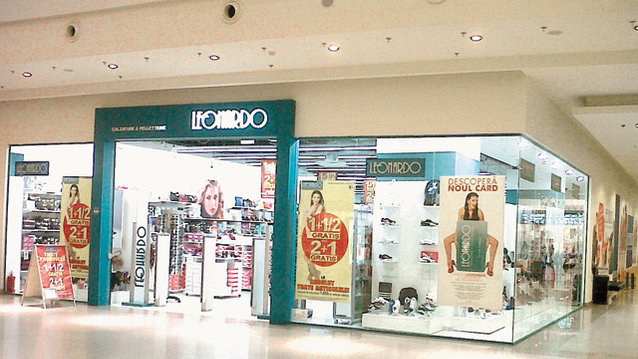
Leonardo had more than 250 stores generating EUR136 million revenue back then. Now after years of reorganization, the retailer expects EUR46 million revenue for 2013, about three times lower than before filing for insolvency, from a network of 140 stores.
“Leonardo’s reorganization is in full gear with a plan voted and approved. We will soon enter the last year of this plan. The steps taken by Leonardo largely focused on internal reorganization,” says Radu Anton, general manager of Leonardo.
“We’re talking interdepartmental flows, management changes, structural changes and outsourcing of certain operations.”
Radu Anton was put in charge of the footwear retailer in December 2010 and has been overseeing the restructuring. Before joining Leonardo he had worked in modern retail for a decade, holding various positions such as sales and customer care manager and store manager with Selgros, Kaufland and Real.
“The purpose (of the reorganization process i.e.) was to boost efficiency of internal resource usage and make sure we reach the sales volume budgeted. The major effects we got were sizeable reductions in overall operating cots, personnel costs and logistics costs and a significant increase in the human resource productivity.”
Radu Anton says the organization is healthier than the year before and has the capacity to carry on all the steps taken as part of the reorganization plan.
Leonardo is currently employing 1,400 people some of whom on maternity leave, the company says. The Finance Ministry website showed about 1,100 employees at the end of 2012, 500 fewer than the year before. The data do not include the people staying home on maternity leave. The retailer had almost 2,400 employees in 2008.
The reorganization does not stop at the number of employees and internal costs only, but extends to the store chain. Leonardo started 2013 with about 140 stores. “It is a year of detailed analysis and clear conclusions about the profitability of each store.”
Radu Anton explains that after five years of crisis the attractiveness of many retail spaces on the market has changed, regardless of their location.
“Some have improved, while others have lost some of their attractiveness. Unfortunately, some owners cannot seem to understand the current economy and have kept rents unchanged or only slightly cut them.”
Under the circumstances, Leonardo’s general manager says the retailer sees itself forced to take all the steps necessary to ensure profitability of its stores even if that means closing some of them and relocating others to better locations.
Leonardo will constantly analyze sales per square meter and per store to decide potential relocations and closures. The officials did not say how many stores they expected to have at the end of the year.
The company does not specifically look for retail space in malls or in street front locations but analyzes the sales potential of a location and negotiates the rent and then analyzes the profit potential of the stores and the time it takes for it to get a return on its investment.
Leonardo expects EUR46 million sales in 2013, down from EUR49 million in 2012. That is because consumer spending continues to decline and Romanians continue to go for the cheapest products they can find.
In battling the crisis, Leonardo chose to focus on the low price segment, on high volume sales. A pair of shoes it sells costs 80 lei (EUR18) on average.
Competition on the low-priced segment, however, is getting fiercer.
Polish CCC brand introduced as a franchise by Peeraj in Romania has expanded to 15 stores in one year since arriving in this country, to catch up with Deichmann and Leonardo, the main competitors on the low-price footwear market.
CCC is one of the most important footwear retailers in Poland with almost 400 stores. It then expanded on the neighboring markets and focused on Eastern Europe.
Leonardo’s leading position is therefore challenged, with Deichmann posting EUR40 million revenue compared with its EUR49 million last year.
Deichmann is positioned as Leonardo on the low to medium-priced footwear segment. The other top ten competitors, Otter, Benvenuti and Humanic target people with above-average incomes. (EUR1=RON4.4603)
(English version by Loredana Fratila-Cristescu)